


Infinity: Beyond Operation Mazebreaker
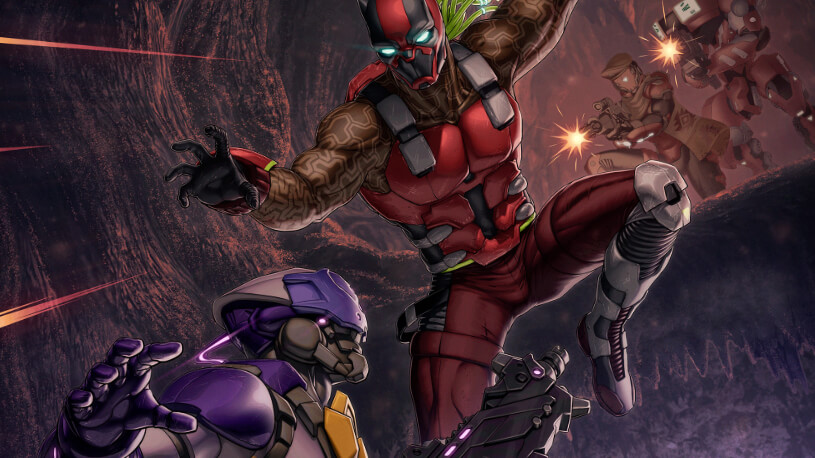
Corvus Belli präsentieren die Beyond-Erweiterung zu Infinity: Operation Mazebreaker.
Infinity: Beyond Operation Mazebreaker
Operation Mazebreaker, the new two-player battle box for Infinity, follows the same schedule of previous battle box releases with a companion product that allows you to expand both forces with three miniatures per side. We are talking about the Beyond Operation Mazebreaker box.
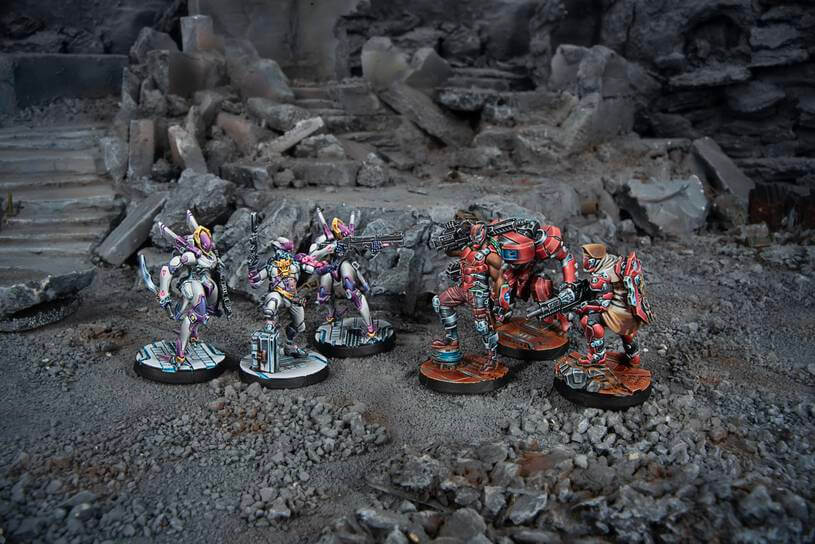
This box consists of 6 miniatures—3 for ALEPH and 3 for Nomads—which complement the 7 miniatures per side included in Operation Mazebreaker. The miniatures are:
ALEPH
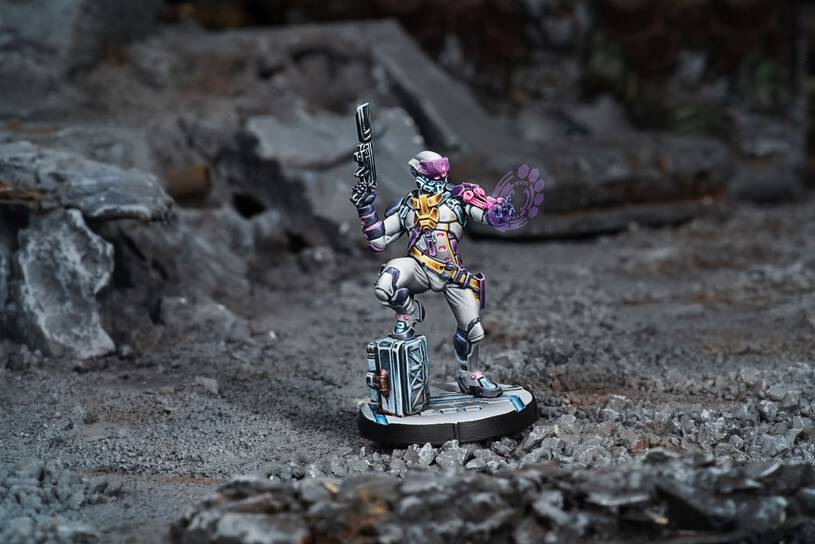
- Dasyus (Hacker, Submachine Gun)
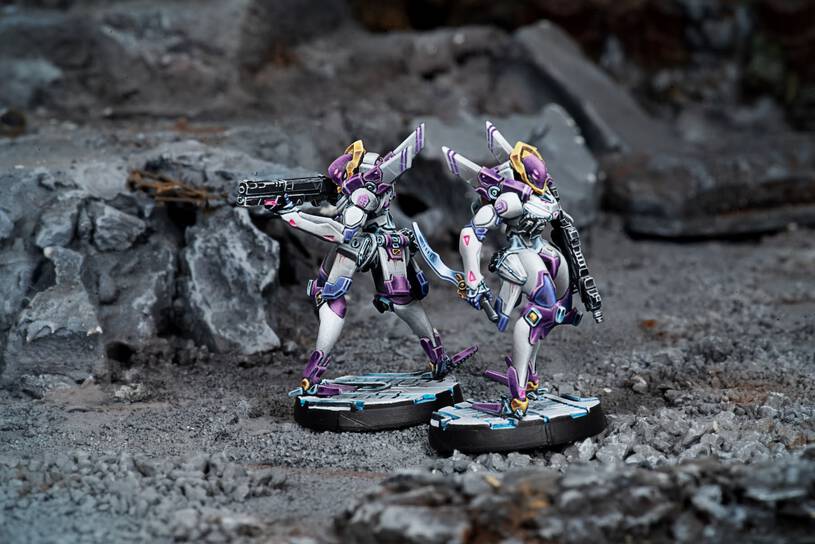
- Kinnara Scoutbot (Submachine Gun)
- Kinnara Scoutbot (Vulkan Shotgun)
Kinnara Scoutbots
OperationS realizes that the real threats are out there, hiding far away, beyond the reach of those who enforce law and order. Large projects need to be kept out of sight and away from ALEPH’s surveillance and monitoring systems. The flow of supplies and materials, field tests, staff transfers… none of that can show up on satellite-based tracking networks or on street surveillance cameras. Hence, the wilderness and the frontier, both on planet surfaces and in deep space, have become new hiding places for AI criminals, despite their drawbacks. These circumstances led OperationS to decide it needed a unit that, in addition to being indigestible to the local megafauna, would be capable of operating in these no-man’s lands, those data vacuums governed by lawlessness and plagued by extreme violence. This subsection of the SSS was eventually proven right, as the discovery of Shinju added a new theater of operations to the long list of frontier territories in the Human Sphere, which features the frozen plains of Svalarheima, the suffocating jungles of Paradiso, and the Ariadna Exclusion Zone, among others.
Aside from Shinju’s barren lands, the so-called Novaro Area of Interest, located on Akiyama, the planet’s largest moon, evidenced those needs and OperationS’ wisdom in developing its Kinnara Scoutbots, which were excellent in the deadly tangle of that permanent source of conflict. The Scoutbot program focused on developing a remote robotic unit capable of moving around and surviving in the wilderness, as well as infiltrating and penetrating deep into uncharted territory. Drawing on the design of the Tacbot series, engineers were able to optimize the weight of the materials and enhance these remotes’ vertical-motion and off-road capabilities. To broaden the scope of its operational capabilities, two different versions were developed: an airborne version, designed to exploit basic local assets, and a forward-deployment version with advanced recon capabilities, building upon the lessons learned from the remote mapping units used by O-12’s Bureau Tiandi. The virtuosity that the Scoutbot prototypes displayed, both in deployment and in combat, earned them the code name Kinnaras, after the human-bird hybrid musicians of Hindu mythology, which is always a source of inspiration for OperationS units. And rightly so, the Kinnara Scoutbots move around the area of operations as if performing an intricate dance where death takes the lead and they join in, with their weapons resounding in perfect harmony.
Dasyus
The Dasyu, the Dark Ones, were hostile Vedic demons. The mission of the Dasyu within the Special Situations Section is to be the eyes and ears of the field commander, collecting tactical information about the enemy through in-depth scouting missions and clandestine surveillance behind enemy lines. They are helped in the completion of their missions by spy satellites, carrying out sensor, electronic and communications tracking. Apart from their own scouting operations, the Dasyu are also specialized in personnel and material clandestine recovery operations, the capture of prisoners, target acquisition, and the elimination of designated targets.
Dasyu troopers are undetectable, they can stealthily penetrate enemy territory, infiltrating their facilities, striking with the speed and force of a lightning bolt and then disappearing without leaving a trace. Most of their operations are classified as top secret, meaning that there are no records of them, implying that they probably break international law. It is said that the SSS has an anti-VIP team at its disposal, made up of impossible to identify Dasyu, assigned to accomplish Search and Kill missions. The targets for these missions would be those political-military leaders considered to be actively hostile and against the secret plans of the AI. Whether this is true or not, the Dasyu lack pity or mercy and, within the Intelligence services community, are considered to be ALEPH’s unofficial execution.
Nomads
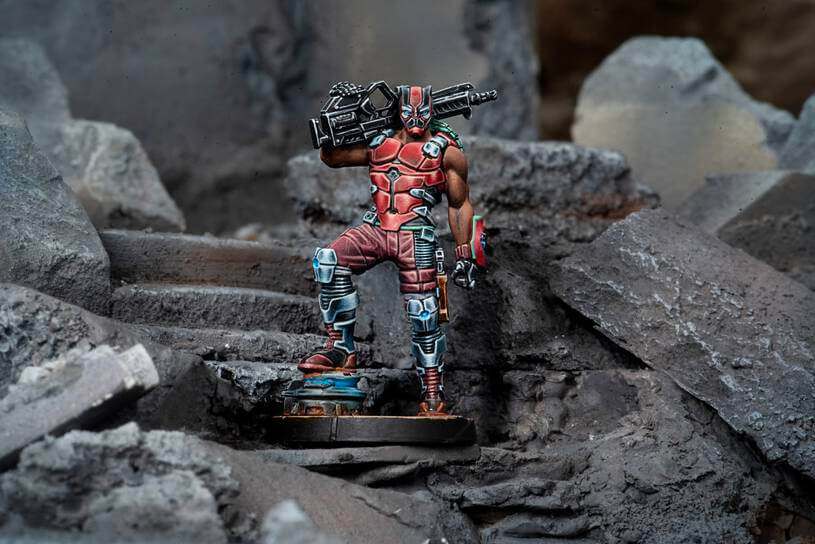
- Shifta (Thunderbolt)
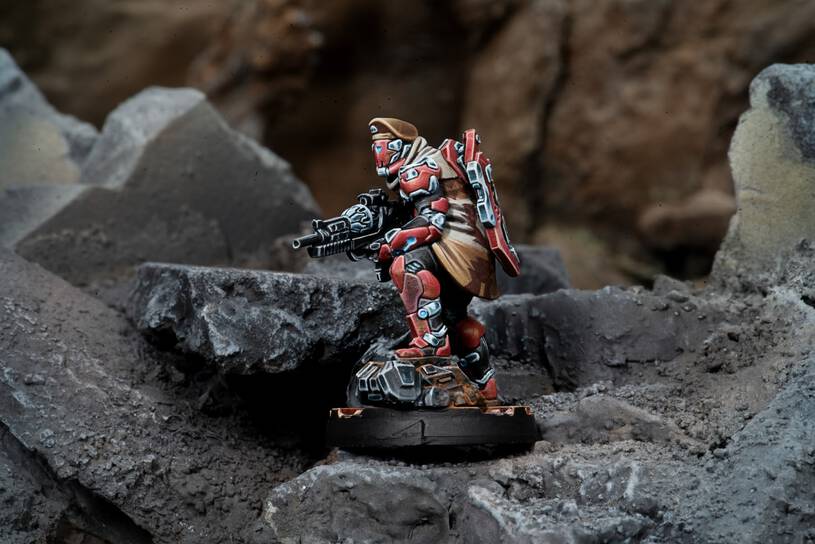
- Coyote (MULTI Marksman Rifle)
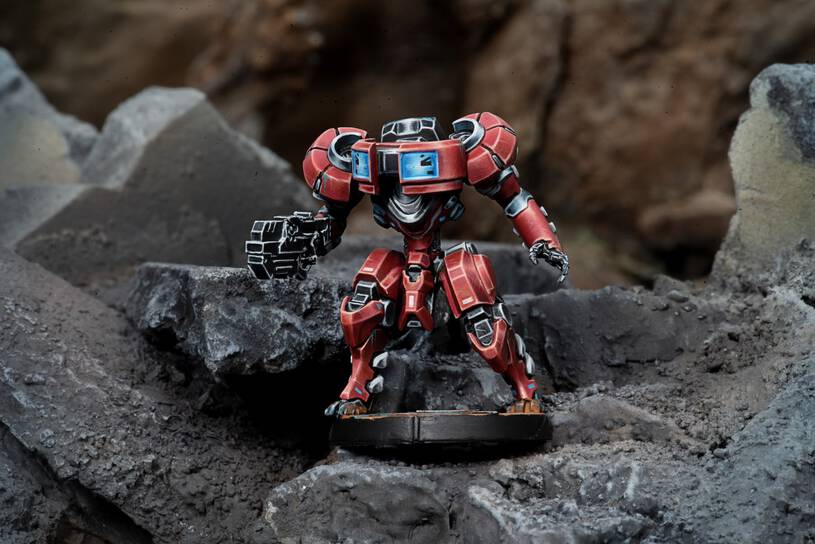
- BambaBot (Chain Rifle)
Shifta
Next to one of the environmental training modules of the Jurisdictional Command of Corregidor you’ll find the barracks of the Shifta Insertion Team, the only facilities featuring an indoor cemetery. It’s roughly fifty gravestones contain only a Cube each and some tissue and DNA samples. Most of those Cubes are damaged beyond repair, and they are the last remaining testament of the Corregidoran soldiers who sacrificed their lives for the sake of their fellow citizens. They were all members of Surface TeamThree, or ST-3, a unit regarded as the soul, the predecessor, and the foundation of the Shifta Insertion Team. Surface Team Three was a security unit for surface industrial operations. To foster team spirit and cohesion, all its members hailed from Lazareto modules inhabited by East African descendants, which gave the team a very solid ethos based on their shared traditions and superstitions.
Realizing the need for more units with the skills to operate on planet surfaces and turn the terrain into an asset and a weapon against the enemy, the Jurisdictional Command of Corregidor resolved to disband and rename ST-3. Volunteers were recruited to join that handful of surviving ST-3 soldiers, and they were trained more intensively than their predecessors in tracking, deployment, survival, and combat techniques. Their job wouldn’t be limited to protecting Corregidor’s interests and personnel on planet surfaces, as they would also engage in insertion and extraction missions in enemy territory.
This new unit was given the name Shifta, honoring those brigands, outlaws, and rebels of East Africa whose tales had a certain romantic aura that made them resemble African Robin Hoods, and they would have a comparable operational role. The Shifta Insertion Team was tasked with carrying out ambushes and raids, as well as the deep insertion of civilian and military personnel into an area of operations, ensuring their safety at all times. In order to accomplish this, they needed to be fierce and sharp in combat, as well as selfless, committed, and skilled in maneuvering and navigating the terrain. This new unit must be capable of succeeding and surviving in situations like the one in which ST-3 had only managed to accomplish the mission at the expense of its own existence. And the only way to rise to such a challenge was to be better, but without ever forgetting the indomitable spirit and unwavering commitment of ST-3. They honed their skills through rigorous training, and the spirit of that unit was kept alive not only thanks to the mausoleum at their barracks, but also through the ritual of K’uribani (ቁርባን, Amharic for “communion”). Using similar tech to that of the sensaseries on Maya, this ritual allows every single Shifta to experience first-hand ST-3’s last operation through the fragments that could be recovered from their damaged Cubes. This way, they can feel the anguish, the resourcefulness, and the bitter triumph of those brave souls, and forge an unbreakable bond with them. Moreover, each of them is given a tissue sample from an ST-3 fallen soldier, who, according to neo-African mysticism, thus becomes their companion and guardian angel, watching over them on the battlefield as well as in their private lives. All Shifta accept this belief as a matter of fact, regardless of whether or not they hail from one of Lazareto’s African modules. This could be a cause for concern, but the shrinks of the Daktaris unit bear with it, knowing that it provides these troops with a psychological mechanism for comfort and reassurance.
Equipo de Reconocimiento y Maniobra Coyote
Juan Sarmiento—the Mexican General, a veteran of the Central American Wars who knew well the deadliness of surface operations—arranged a joint training program in the environmental modules of Praxis for the troops of the Jurisdictional Command of Corregidor. This was supposed to be a temporary arrangement while a couple of those units were built in the outer area of Lazareto. These modules were to be fitted with specific programs for extreme environmental conditions, and Corregidoran troops were to complete their basic training there. From then on, surface operations ceased to be the Achilles’ heel of this mothership’s troops, who finally matched the performance of any other force hailing from a gravity well. However, despite their efficiency, none of these Nomads feel comfortable while carrying out these types of operations. A true meteorhead, a true man or woman of space, will always be yearning to leave the planet surface to get back out among the stars, which is where they find their true home. And yet, amongst the most hardened Corregidoran soldiers, there are still a few who enjoy being at the very bottom of a gravity well, surrounded by a hostile ecosystem and battered by harsh weather. These people, with such an odd mindset for people born in Corregidor, the weirdest among the weird, were to constitute the core of the Coyote Team.
The Coyote Team was expected to become their field guide, by integrating into other units and providing them with their expertise, so that they could maneuver smoothly through any hostile terrain. They would also serve as expert consultants in the tactical planning of operations, and sometimes even at a strategic level. These tasks earned them the codename Coyotes, not so much due to their knowledge of the terrain, but rather because of their ability to get people in and out of very dangerous areas. However, they stood out most when operating on their own, either completely alone or accompanied by their faithful BambaDroids, their versatile off-road Remotes, which can be set to operate either autonomously or synchronized, and whose syncopated movements earned them their nickname.
This unit is tasked with conducting deep reconnaissance operations in no-man’s-land, as well as carrying out the insertion and extraction of equipment and personnel in extremely dynamic situations. The Coyotes are the unexpected competitive advantage of the Jurisdictional Command of Corregidor, the specialists that no one would expect to find among the Nomads. These operatives can really make a difference far away from their orbiting mothership, down in a gravity well, which is a sort of “home away from home” for these rugged commandos who are the eyes and hands of Corregidor on the ground, and the oddest of all meteorheads.
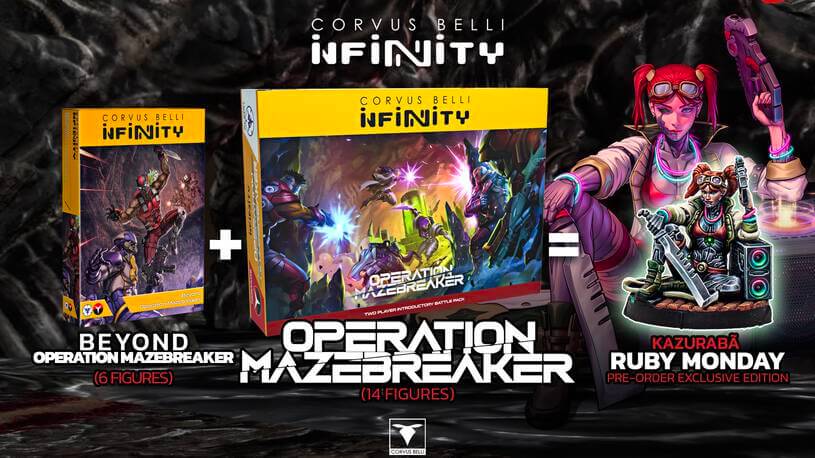
Get Beyond Operation Mazebreaker together with the Operation Mazebreaker battle box in the spectacular bundle available for pre-order on May 29th. This bundle includes the exclusive Ruby Monday miniature for free when you purchase both Operation and Beyond boxes!

Quelle: Corvus Belli Blog
Anzeige:
Infinity und Aristeia sind unter anderem bei unseren Partnern Fantasywelt, Minyarts und Taschengelddieb erhältlich.


Ich find’s schade das der Coyote mit 2 verschiedenen Bots rum läuft, aber nur einen bot dabei hat.
Sonst sind die alle cool
Der Bot ist entweder oder. Pehriperial oder eigenständig und vOrder generierent. Je nachdem, ob du die FD oder die FTO Variante des Coyote nimmst. Von daher schon elegant gelöst.
So wie ich das sehe braucht der Droid lediglich irgend einen coyoten in der Combat group, wärend der FD noch ein bambabot zusätzlich haben kann
Insgesamt ne coole Box. Nur diese Surface Division Sache kommt mir spanisch (oder eher mexikanisch) vor 😉 CJC hat mehr Neuheiten aber Aleph fixed mich etwas mehr an.