

Dropzone Commander: PHR und Scourge Fokus
Bei den Dropzone-Previews geht es mit den nächsten Fraktionen weiter.
Dropzone Commander: Countdown to Drop 07 – PHR Faction Focus
For our next Faction Focus, we’re going to take a look at what happens when you take baseline humans, add nanomachines, make them all eerily pretty and smooth down all the edges on their vehicles. It’s time to introduce you to the enigmatic PHR, and talk about why they might be the faction for you.
Post-Human
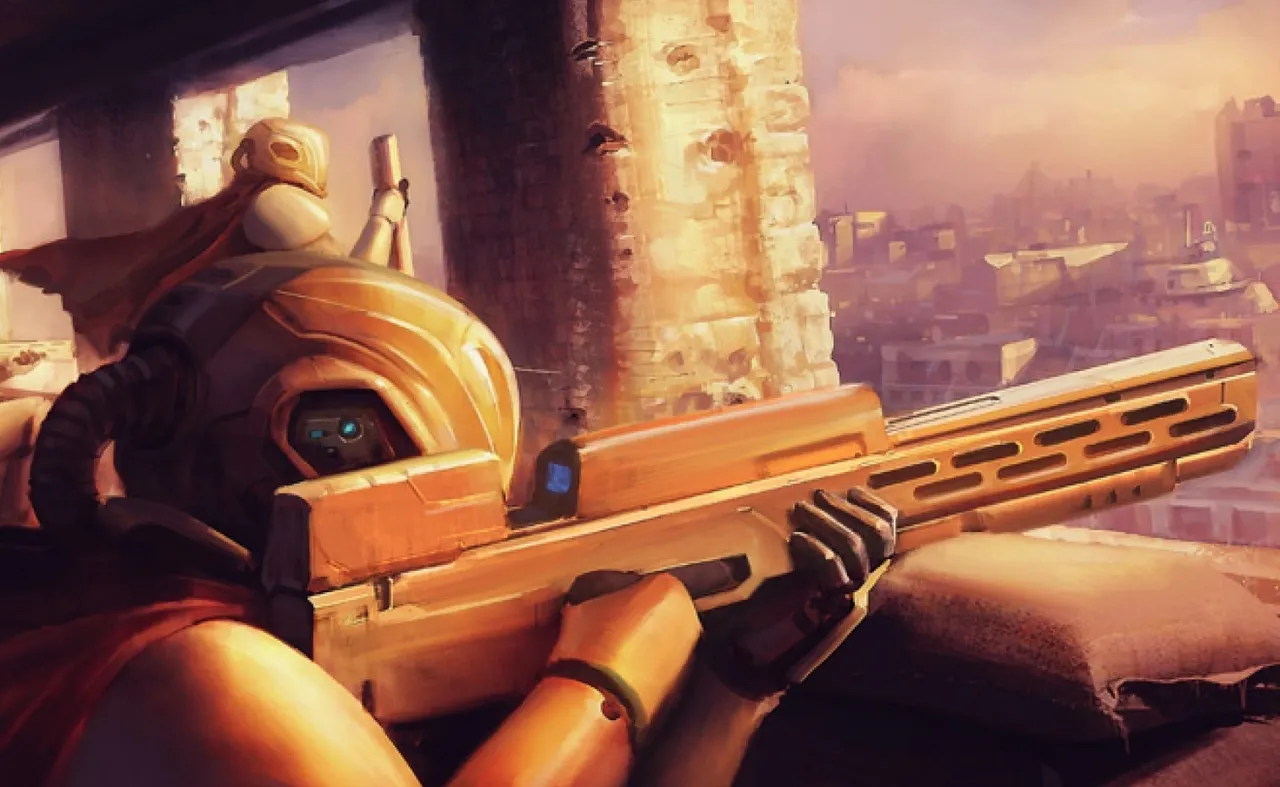
The Post-Human Republic, or “PHR,” are the descendants of one of the few groups that survived the Scourge invasion. A year before the Scourge assault, the White Sphere – an unassuming pearlescent orb of unknown material – crash-landed on Earth and, when plugged into the network, gave a warning to all mankind of their impending doom. It instructed them to gather at a specific location and flee known space en masse, abandoning any who wouldn’t follow.
Most of humanity ignored the Sphere’s warning, but those who followed it – later bitterly dubbed “the Abandonists” – gathered to jump away. Earth Alliance Authority ships ordered them to stand down, and the Abandonists shot their way out. Most escaped to their unknown destination, but the three hour civil war crippled Earth’s defences, and 200 years later, many hold them responsible for the impact of the Scourge attack.
Now, the Abandonists’ descendants have emerged as the Post-Human Republic. Under the Sphere’s guidance, their technology has ascended far beyond that of the UCM – their people are eerily beautiful cyborgs, their mastery of drones and cyber warfare is absolute, and while they are few in number, they are the definition of an elite army – easily capable of holding their own against less sophisticated forces.
Often Outnumbered, Never Outgunned
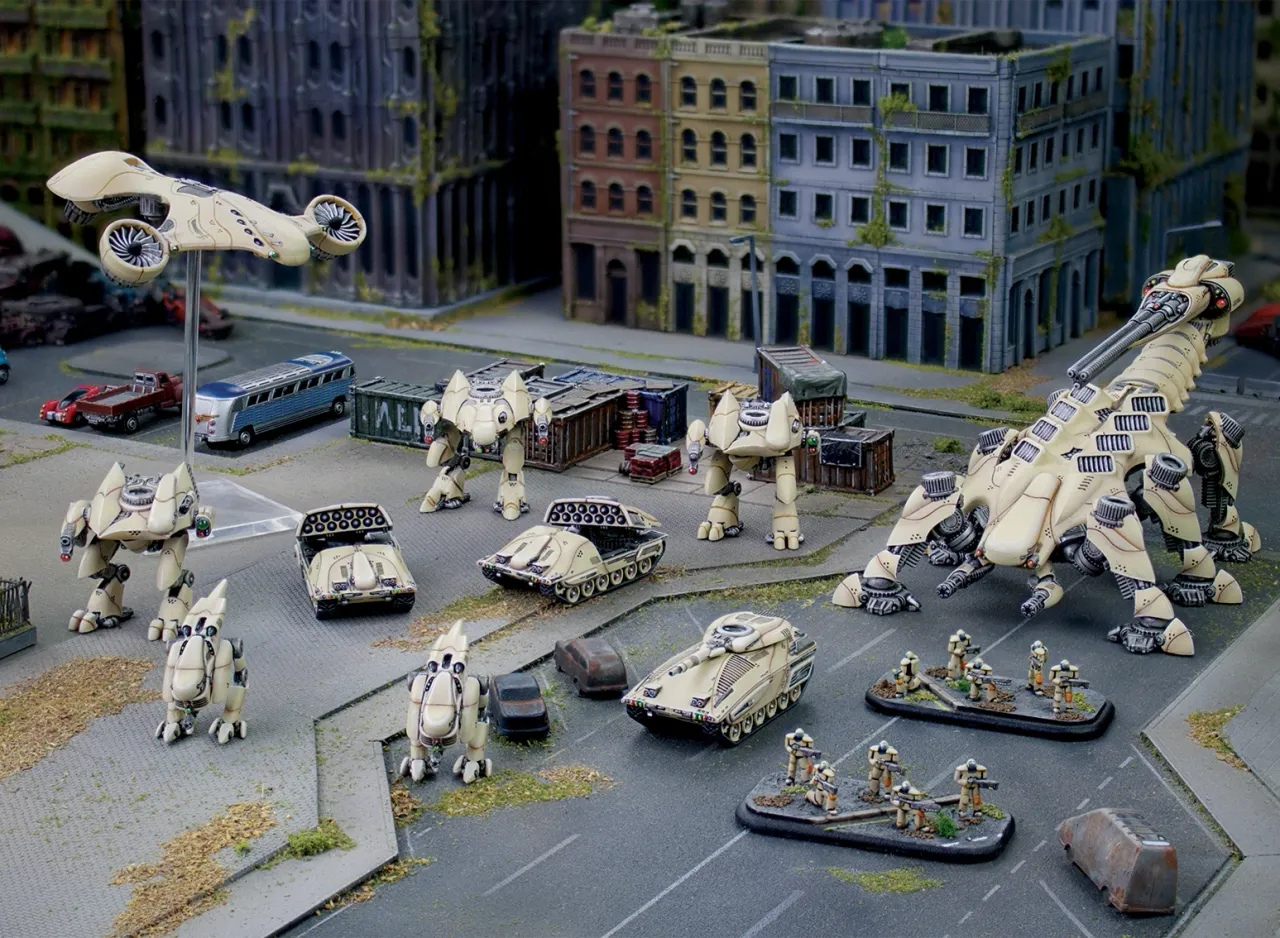
On the table, the PHR are almost always low in model count. Instead of primitive tanks, they stride into battle piloting walkers – bipedal mechs well-suited for urban terrain. These walkers come in many configurations, grouped into “Types,” with Type-1s being their most common, Type-2s being up-gunned and up-armoured heavy tank analogues, and so on.
Many of their weapon systems have parallels in the UCM, but are that little bit more effective. The Phobos AA Walker for example eschews gatling guns for its anti-air role, using a high rate of fire railgun in its place that spits slugs of metal at a terrifying 24″ range – most enemy gunships that can out-range a UCM Rapier or Scourge Stalker don’t have that luxury versus PHR AA. At squad size 1-6, Type-1s, Type-2s and Type-3s can all be easily taken in small or even single walker squads, letting them either work as large focused or multi-role squads for more impactful command cards, or lone agents with dedicated purposes like guarding a flight corridor or softening up infantry before an Immortal assault.
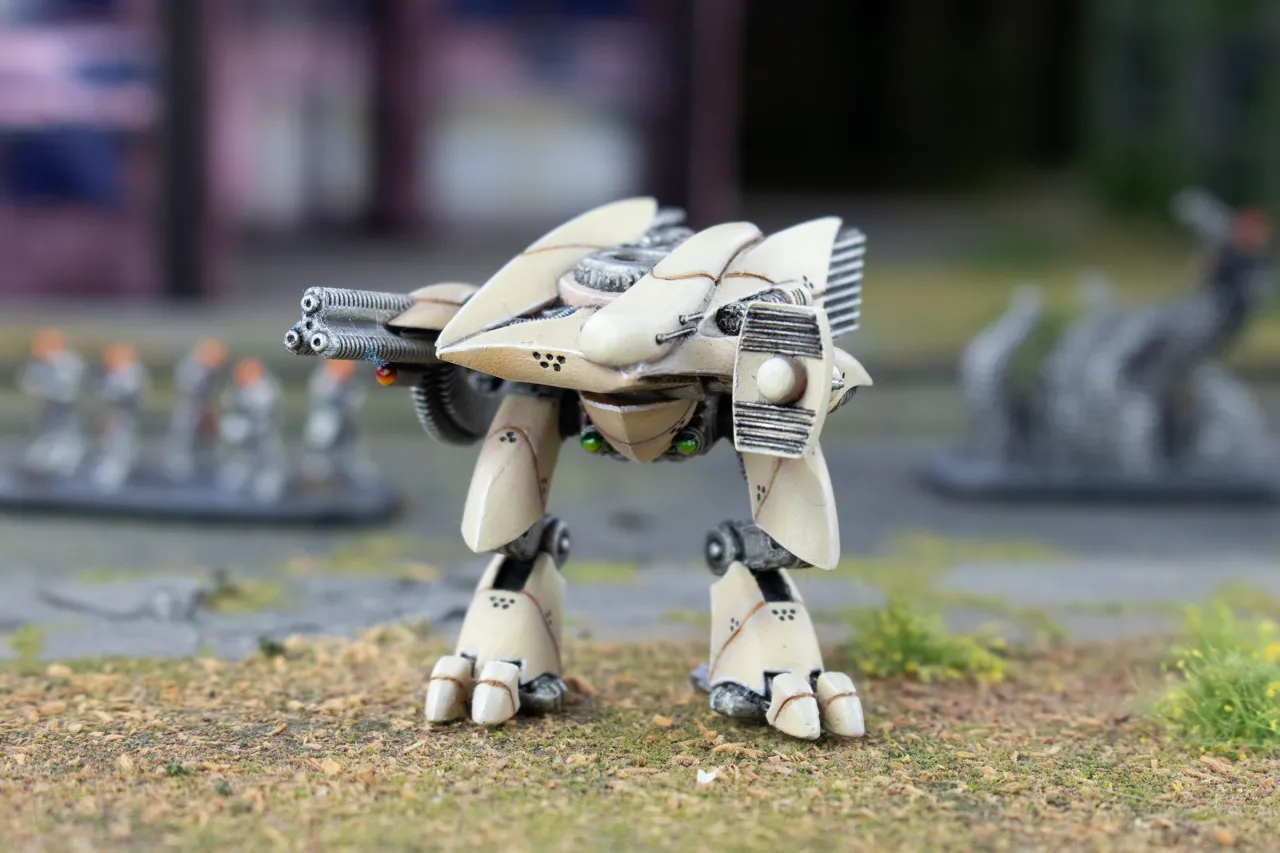
The tradeoff is usually speed, with Republic walkers moving slightly slower than tanks and much slower than Scourge or Shaltari skimmers, but when they build for speed, they have it – the Type-3 “Apollo” and „Hera“ Strike Walkers feature sets of Jump Jets, allowing Squads of Type-3s to leap over buildings with the same speed and maneuverability as true aircraft.
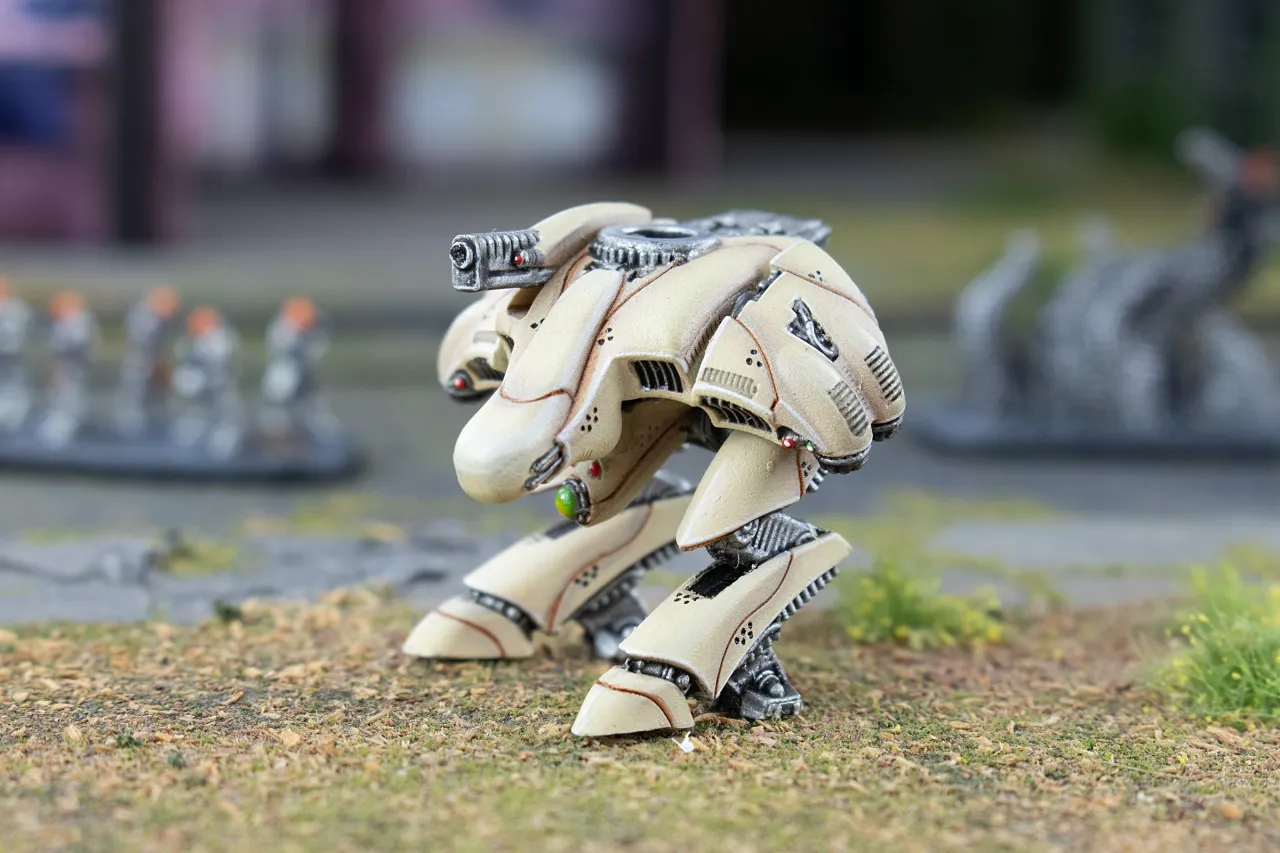
The apex of walker technology has to be the Type-4 Scorpions, however. These gigantic units are iconic centrepieces for any PHR army and come in several varieties.
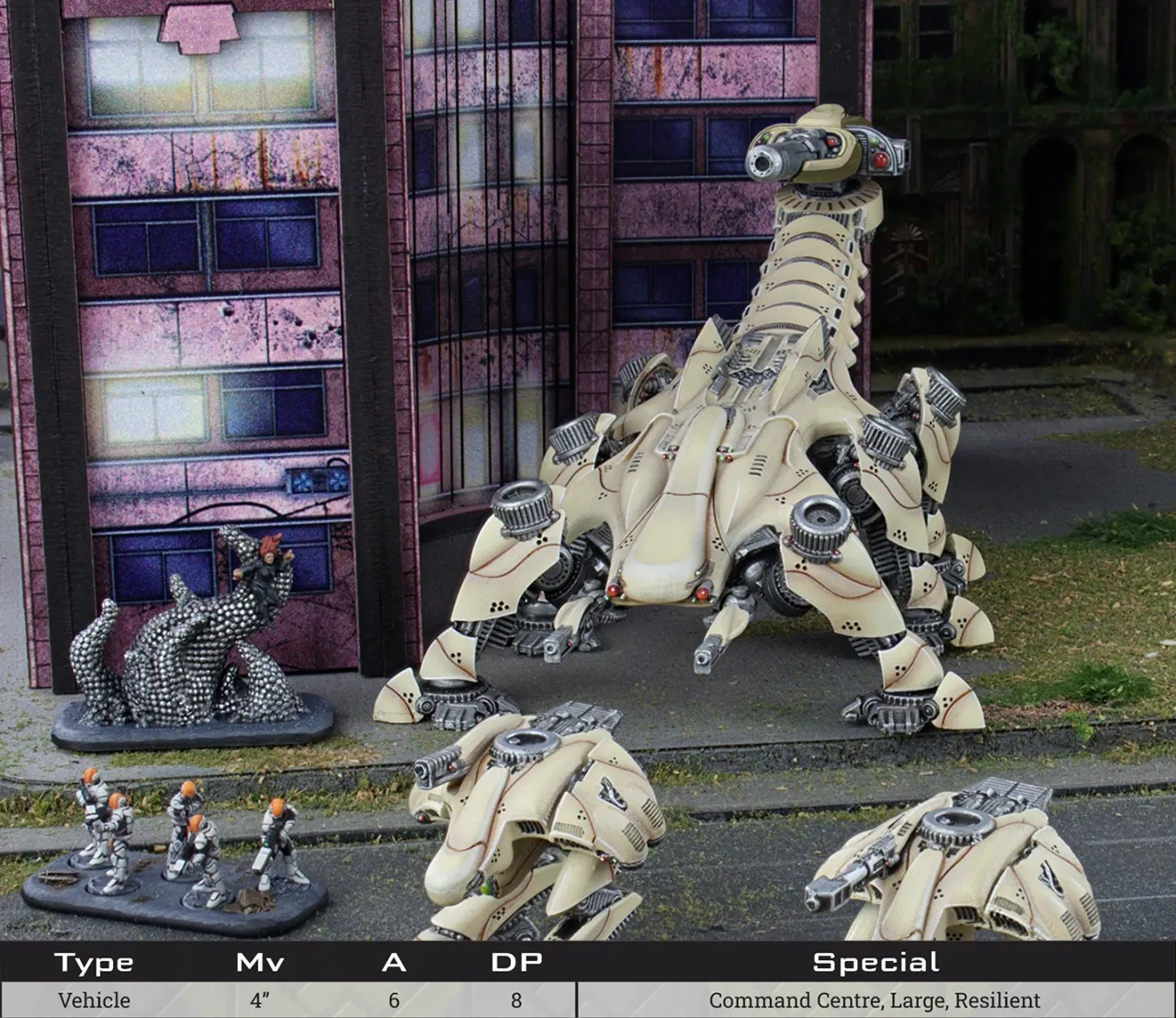
This unit is a monster. At Armour 6 and 8 Damage Points, it takes serious firepower to bring down. As in Second Edition it keeps the Resilient rule, meaning most weapons* can’t cause Critical Damage to it, but its Large size** means it can never be Obscured either. The Type-4 Command Scorpion – a combination of the Nemesis and Bellona variants – also picks up Command Centre and is Rare (shown in its points on the full stat card), limiting the number of Command Scorpion Squads you can bring to one per 1,000 points of game size (so two at 1,750 points, for example).
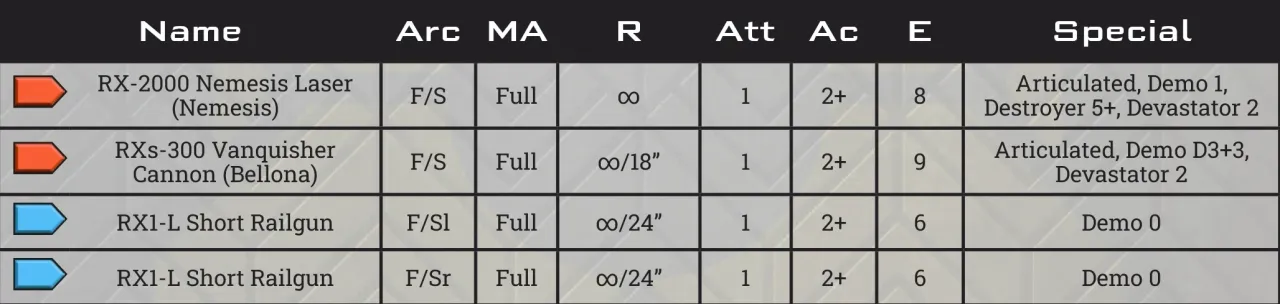
These stat cards are taken from pre-release versions – the final icons for default weapons (blue), variant weapons (red) and paid-for upgrade weapons (green) will be differing symbols so as to be colour-blind friendly.
The blue icon*** indicates that both variants of the Command Scorpion get a pair of RX1-L Short Railguns. The red icon then shows weapons that change by Variant – so the Nemesis picks up an infinite range RX-2000 Nemesis Laser, while the Bellona instead mounts a solid shot RXs-300 Vanquisher Cannon. Both weapons have the Demo X rule that we’ll cover in a later article about urban planning, have Articulated – letting them shoot over friendly units and even some small buildings – and Devastator X, which adds the X value in additional damage when shooting units.***
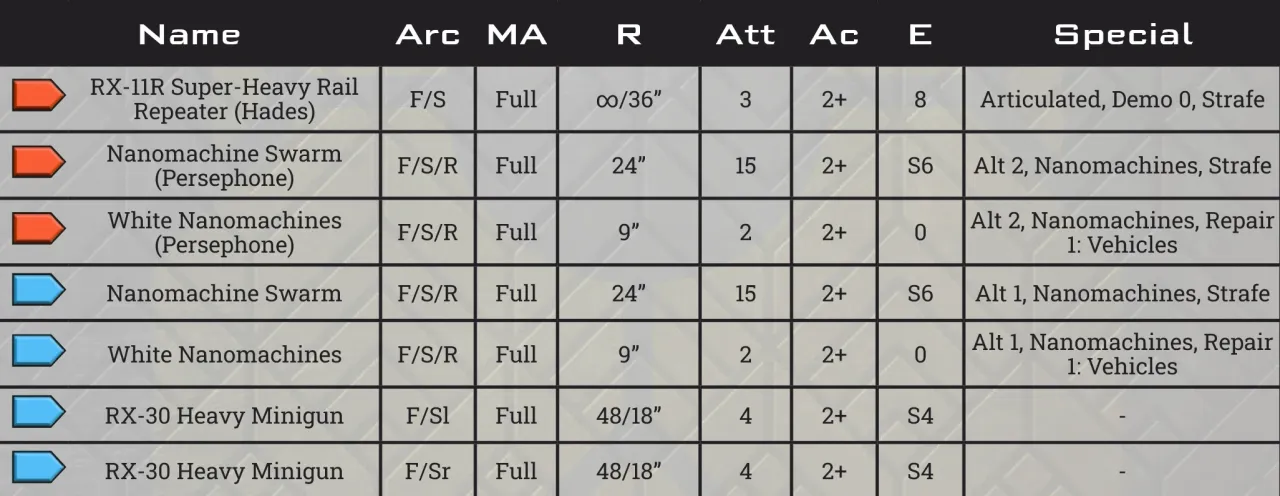
The Battle Scorpion meanwhile is a very different beast. As a separate unit to the Command Scorpion it doesn’t have Command Centre (and also loses Rare), but does get some serious firepower in return. Both variants – the Hades and Persephone – get a pair of RX-30 Heavy Miniguns. As Small arms weapons they can’t hurt anything other than infantry with their 4 shots each, but you can combine them into a single Energy 4 shot if you want – good enough to shred light armour or chip a damage point off a Bioficer Tusk.
Both the Hades and the Persephone also get one Nanomachine Swarm weapon and one set of White Nanomachines**** – these have the Alt 1 rule, meaning you can only fire one or the other when the Scorpion attacks. At 15 small arms shots, the swarm of nanomachines will do horrible things to enemy infantry, and can combine fire for three E6 attacks versus vehicles – definitely enough to scare real armour!
The scorpion can also release its nanomachines on a Repair order – the cloud of tiny drones roll to hit against a friendly vehicle in range, restoring one damage point per hit.
We then get into the variant weapons, marked with red icons – the Hades picks up an RX-11R Super-Heavy Rail Repeater on its tail mount, a high-power long range railgun with Articulated – letting it shoot over friendly units and even some small buildings – and Strafe, allowing it to split its shots between targets within 3” of each other. With a bit of luck this can easily pop three enemy tanks in a turn, or focus the shots on the same heavier target to reliably destroy it.
The Persephone meanwhile forgoes the rail repeater in return for a second set of nanomachines – the Alt 2 rule meaning that when you attack, you pick one of the Alt 1 pair and one of the Alt 2 pair. So it can repair twice, repair and attack once, or attack twice for an unholy thirty small arms shots (or 6 energy 6 attacks!).
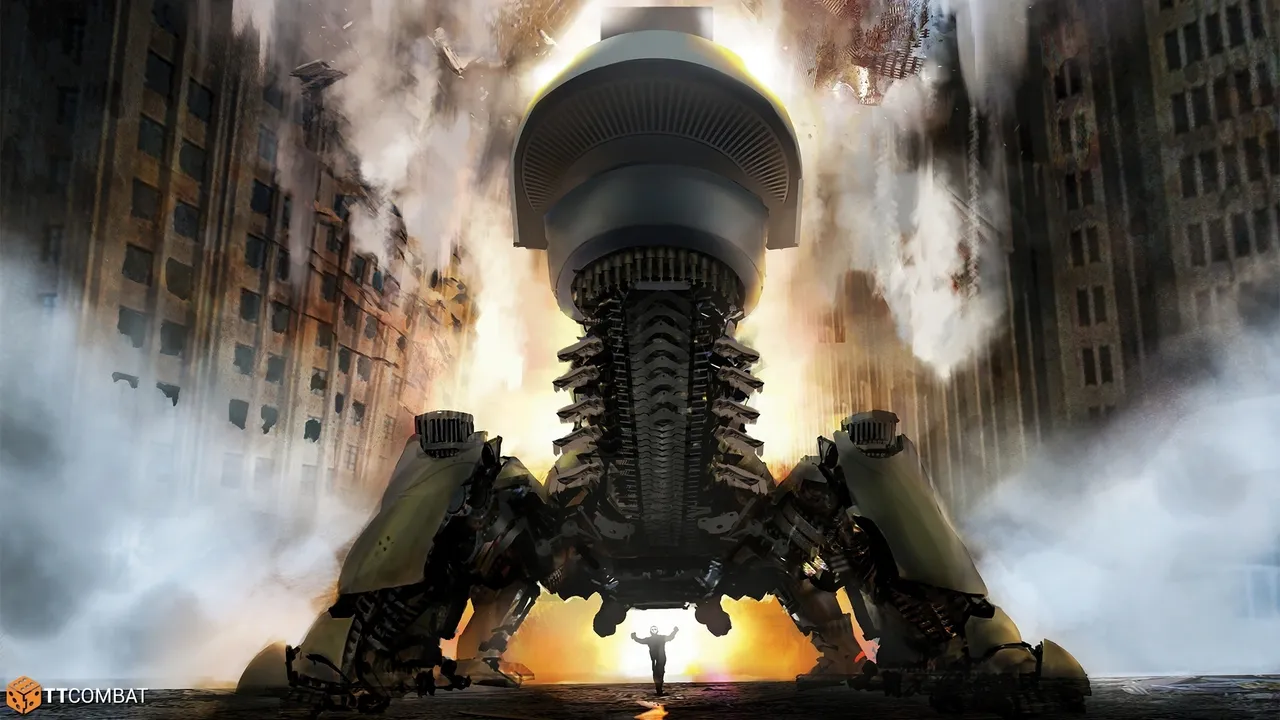
Pictured: The sensible reaction when your opponent tells you they have 38 small arms shots pointed at you.
The Battle Scorpion and Command Scorpion are classic PHR units – slow and purposeful, indomitably tanky, and armed to the teeth.
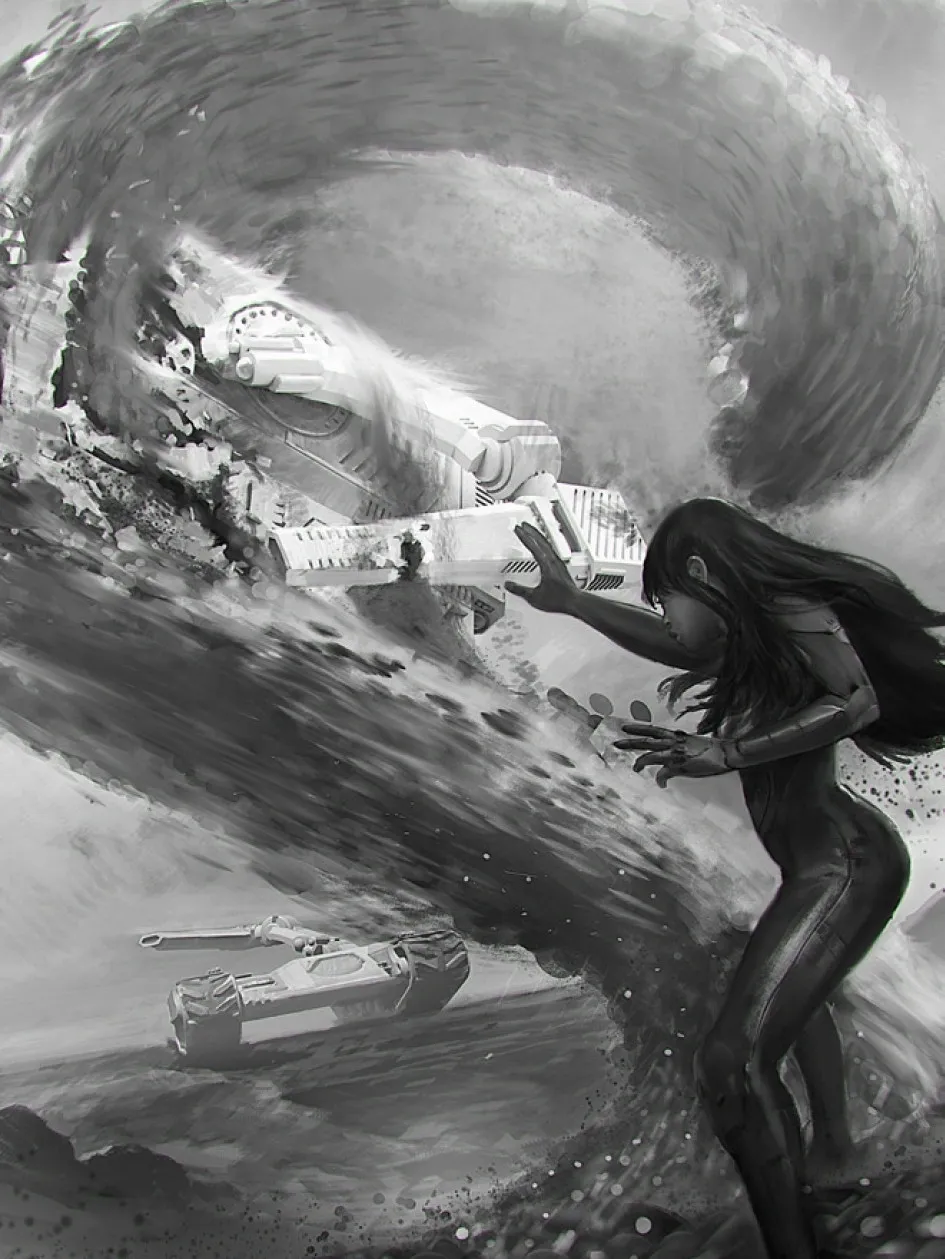
Cybernetic Subterfuge
The PHR have a diverse set of Command Cards available to them. While some cards are straightforward, boosting movement or accuracy on key units or repairing damaged vehicles with swarms of nanomachines, many lean into the Republic’s reputation for subterfuge, hacking and clandestine warfare. The less advanced technology of baseline humans and their opponents is comically easy for PHR spies to override, and a player fighting the PHR can expect to have their plans, engines and weapons messed with constantly.
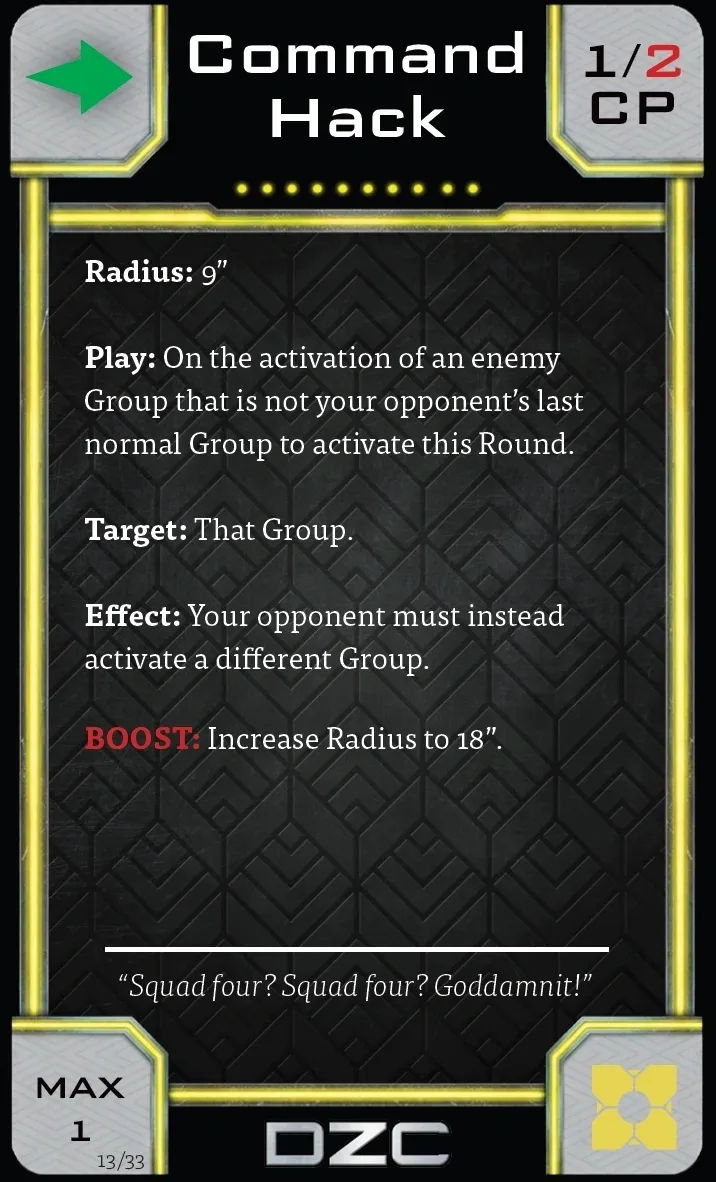
A key example is the Command Hack card – for 1CP (or 2CP with a doubled range), you can simply force your opponent to do something else, activating a different Group to the one planned as their comms break down. At the right time – with objectives being extracted, interceptors on standby, flame weapons needed right here, right now, etc – a simple breakdown in the chain of command can be devastating.
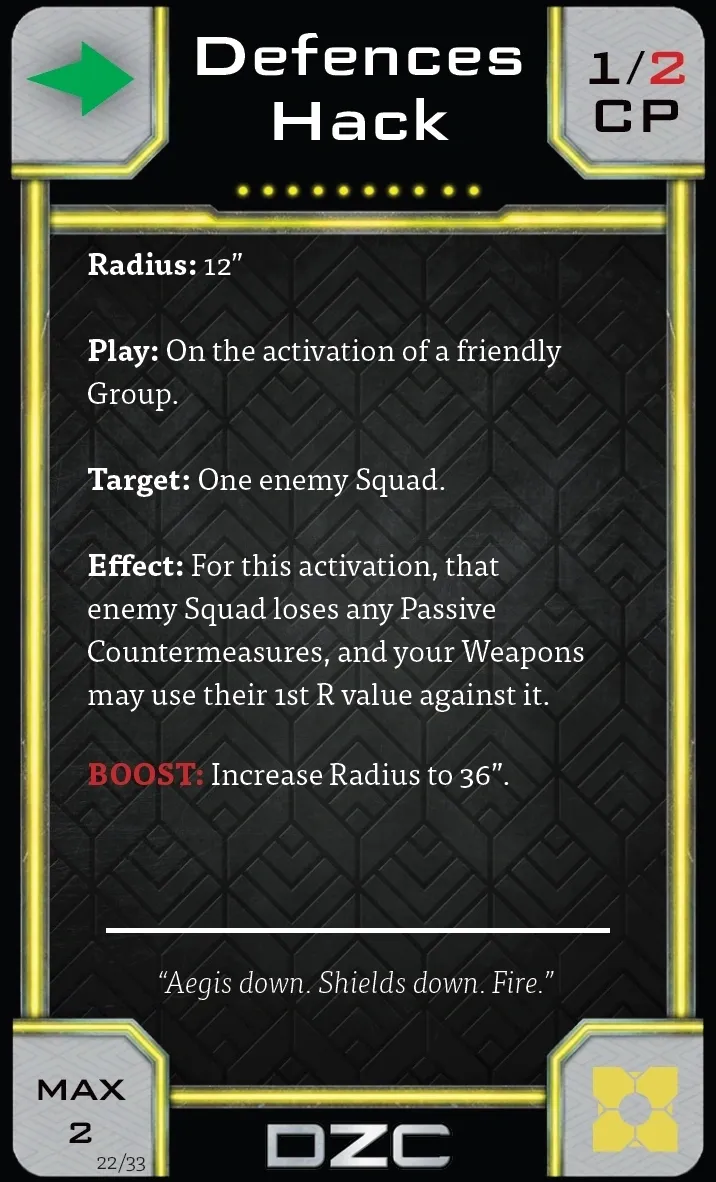
Defences Hack meanwhile can be used to prime a target that thought it was safe. With an elegant „adjustment“ of code, the target’s active countermeasures fail, shields flicker and die, and suddenly your Ares’ railguns – already a respectable 24” range – go to infinite range against that target.
These are just a couple of their powerful cards – Spy Ring can ruin your opponent’s plans for a whole round, Signal Encrypt makes sure that your plans aren’t messed with too much, and Weapon Hack is going to have your opponent feeling very, very nervous about deploying their big guns in line of sight of each other.
We’ve got a lot more to show you for the PHR, especially when it’s their turn for their plastic range refresh – in our next article though, we’re covering an important part of the core rules and one of the biggest shakeups – Zones and CQBs. Check back next week for that!
*Weapons of energy 9 or 10 now negate Resilient – a Mythslayer Railgun slug or the Furnace Laser of an Obliterator will absolutely kneecap a Scorpion on a lucky hit, despite it having 200% more knees than standard!
**Large also brings another downside – the bigger hull means more surface area to catch shrapnel when hit by a Blast weapon. Blast – formerly known as Area – usually results in putting down a blast template and rolling to hit once against each unit under it, but if you target a Large unit directly you don’t place the template, and instead roll to hit d3 times. Not only that, but Blast weapons now ignore Resilient, so be doubly wary of high energy blast weapons locking on to your Scorpion!
***Devastator is no longer multiplied when causing Critical Damage, instead doing the flat X number so long as you successfully damage the target. So the Bellona’s fearsome Vanquisher Cannon does 1 damage, +2 for devastator, +1 more if it crits, for 3-4 damage total. It’s also energy 9, which bypasses Resilient and partially breaches the energy shields the Shaltari are infamous for using!
****Nanomachines is a compound special rule, and is faction-specific – some special rules are unique to specific factions, like Nanomachines for PHR or Decon for Bioficers. In this case, Nanomachines combines the Indirect and Ineffective: Zones rules and explicitly forbids attacking aircraft, preventing some of the silliness of anti-air Medusae we saw in second edition.
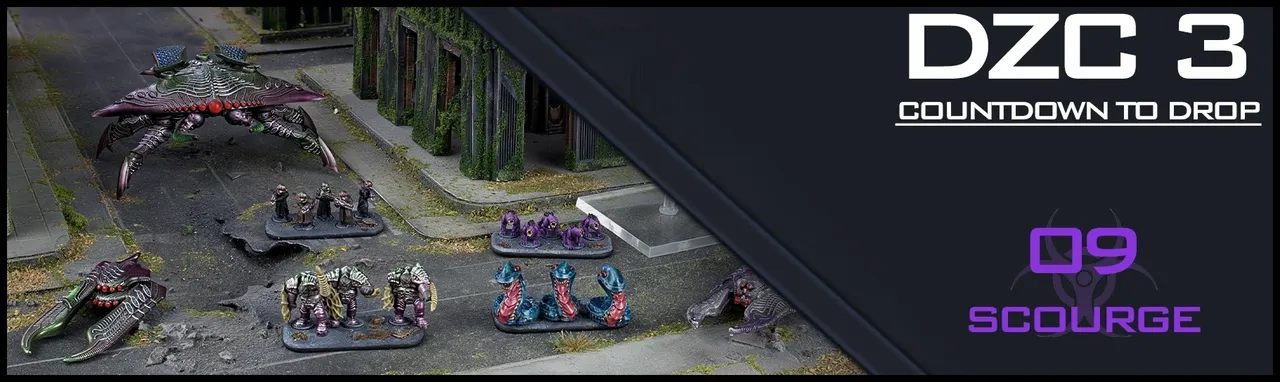
Dropzone Commander: Countdown to Drop 09 – Scourge Faction Focus
In our Faction Foci (I’ve settled on Foci) we’ve covered the new antagonists – the Bioficers – already. The insane AIs are plenty scary but aren’t the original foe of humanity, and in this article it’s finally time to talk about the old enemy. Read on to discover who the Scourge are, how these parasitic aliens fight, and why them infesting your neural pathways and dictating your every move can actually be pretty fun.
The Old Enemy
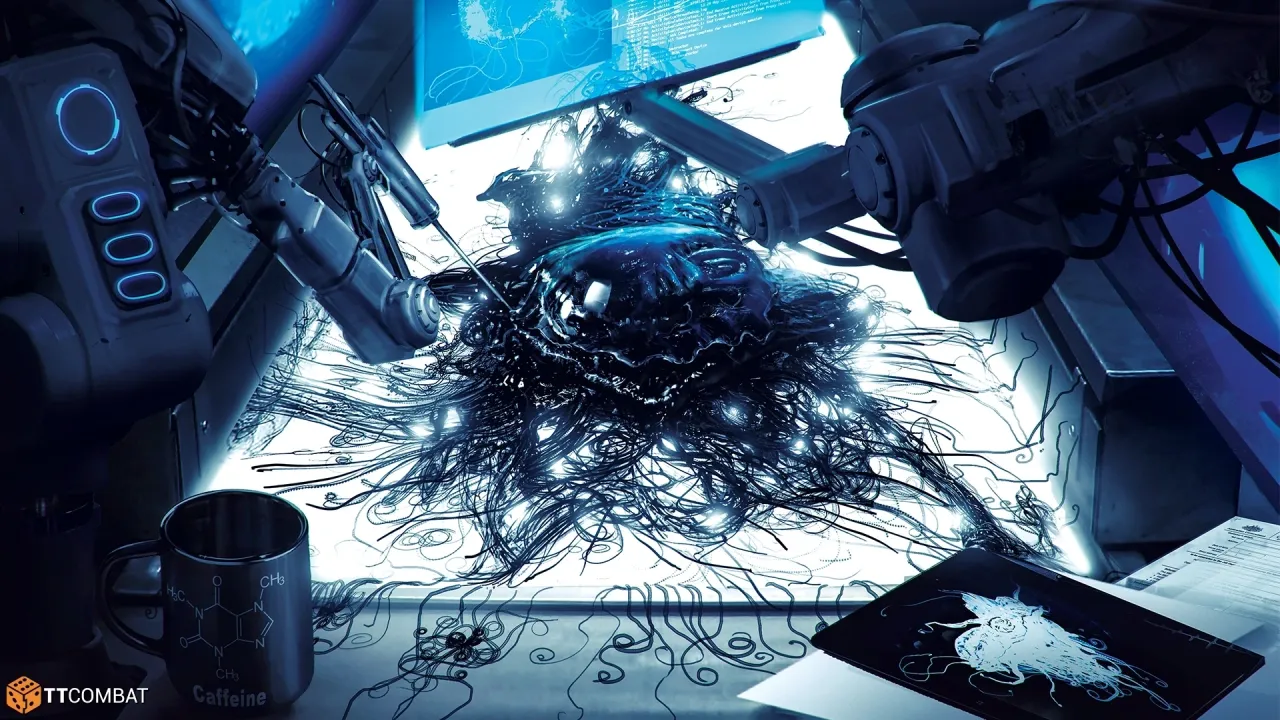
The Scourge themselves are a diminutive, almost pathetic-seeming species of jellyfish-like amorphous parasites. In their natural form they are almost defenceless, but that belies their true capabilities. If given the chance, a Scourge parasite can take up residence in the body of a host – willing or not – and hijack them, turning them into a puppet. There is no resisting this effect, and it’s theorised that the horrified host remains conscious, existing in unending agony and horror as the parasite inside them pilots their body to its own ends.
Not only that, but the parasitisation process extends the host’s lifespan considerably. The only way out appears to be death, and death is always the result when attempts to remove the parasite from the host are made.
This grim fate has been inflicted upon mankind on an interstellar scale. 200 years ago the Scourge attacked Earth and the Cradle Worlds without warning, wiping out the vast majority of humanity in one fell swoop. Those that weren’t killed were domesticated and turned into hosts, their bodies dispassionately repurposed by the Scourge hive mind. Two centuries later, the great enemy are on the back foot, with the UCM’s reconquest having retaken several cradle worlds and hotly contesting Earth itself, but they are far from beaten. Rumours even claim that the parasites have begun an assault on PHR space, and they have been battling the Shaltari for aeons, consuming one race after another as the manipulative aliens throw lesser species in their path.
The Bioficers may be the new threat, but the Scourge have been doing this for a while and are not to be underestimated.

Knifefight Range
On the table, a Scourge army is a vicious, feral thing. Many of their units want to close to point blank range, armed with fearsome plasma weaponry that is ineffective at a distance but devastating up close.
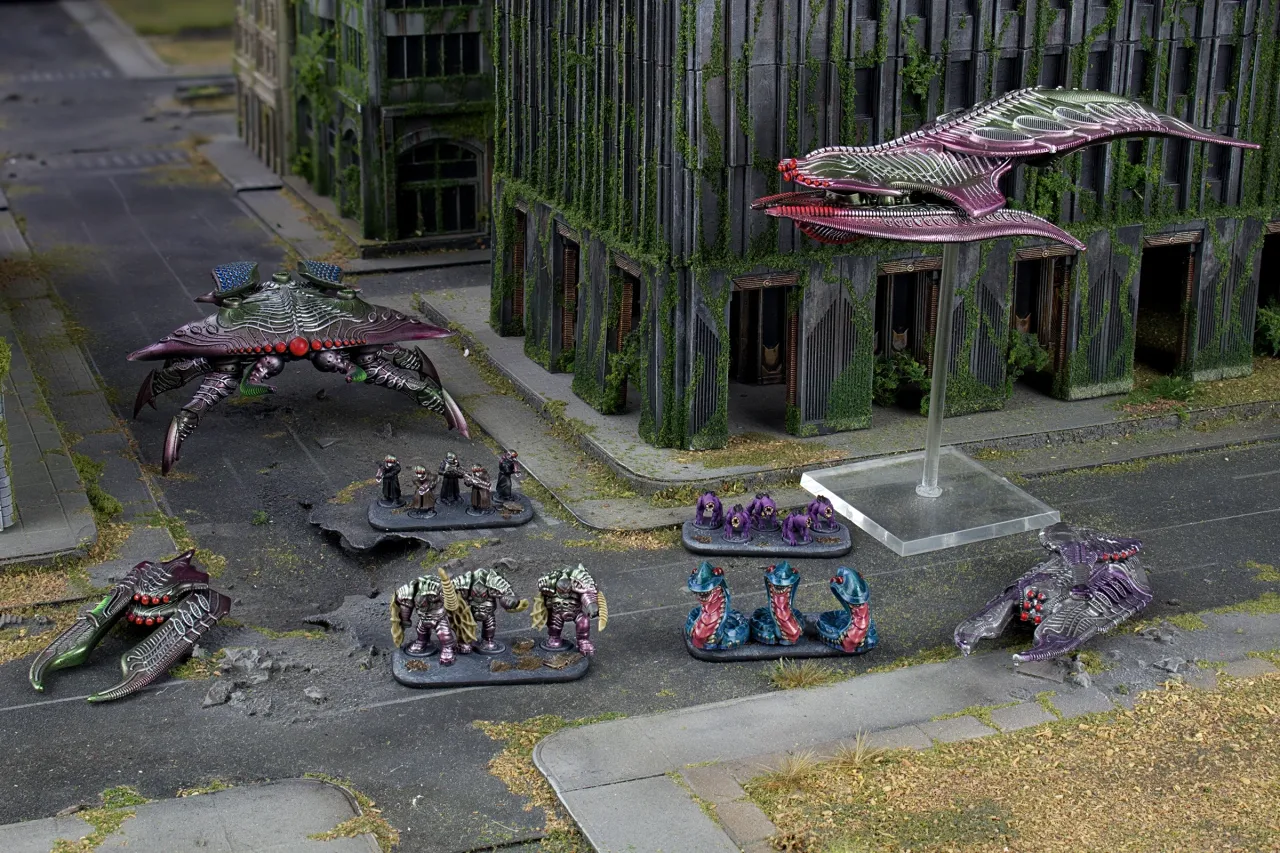
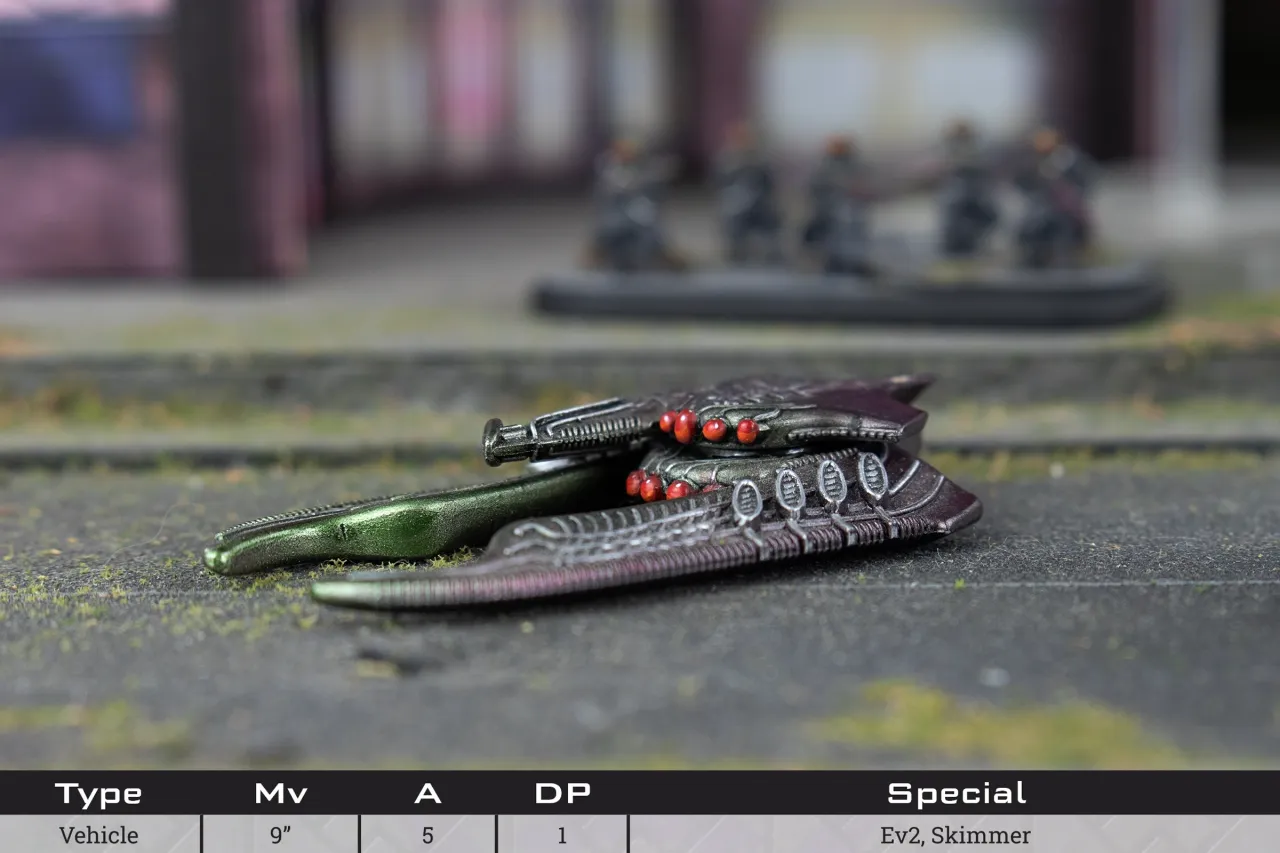
Typical Scourge vehicles are fast and agile hover-tanks, like the classic Hunter Battle Skimmer. Armour 5 is quite light for a main battle tank, but Evasion 2 means that any weapon without Tracking is going to be suffering a -2 accuracy penalty as the Hunter jinks and glides out of the way of incoming fire.
Its plasma cannon’s short range is made up for by the Hunter’s blistering 9” movement, with Skimmer allowing it to move across Poor Ground without penalty, and its powerful energy 7 can bore through even the toughest armour. Demo 1 means a blast of plasma into a Zone will do 2-3 damage per hit, making this indirectly quite a scary unit for infantry in the vicinity as well – remember that every point of damage to a Building is 1 collateral damage to every Squad inside!

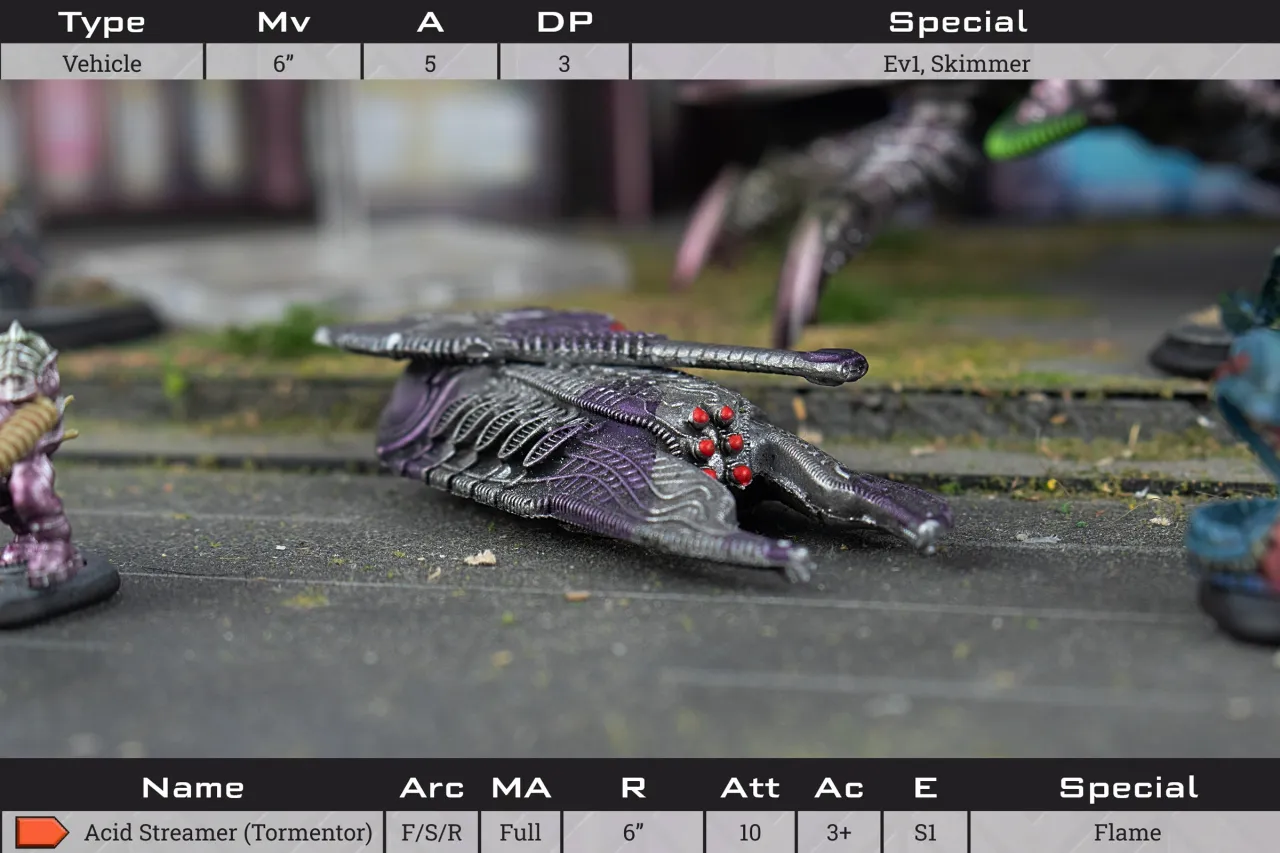
Their heavy tanks meanwhile pick up two more damage points, weighing in at an impressive 3 DP – too tanky to be one-shot by a lucky railgun crit. Their extra bulk does slow them down and reduce their evasion to 1, but that increased size gives more room for heavier weapons, like the Tormentor’s horrifying Acid Streamer. 10 Small Arms shots with Flame will make flesh run like wax, killing any occupants in a Zone in a uniquely upsetting way, friend or foe.*
Insectoid Horrors
Not all Scourge units are fast, however. Some vehicles have been dubbed „Arthropods“ – multi–limbed insectoid machines, often trading evasion for toughness. As with PHR scorpion walkers, these often sport the Resilient rule, gaining immunity to critical damage from most weapons.
The scariest of these scuttling vehicles is arguably the Subjugator. A massive 9 DP helps compensate for its low armour, and it packs considerable firepower in the Electroweb Caster, a potent Energy 8 short range attack. Its Razor Claws only have a range of Close Combat or „CC“, meaning they require physical contact to attack with, but the Assault special rule allows them to attack even if the Subjugator disembarked this round.**
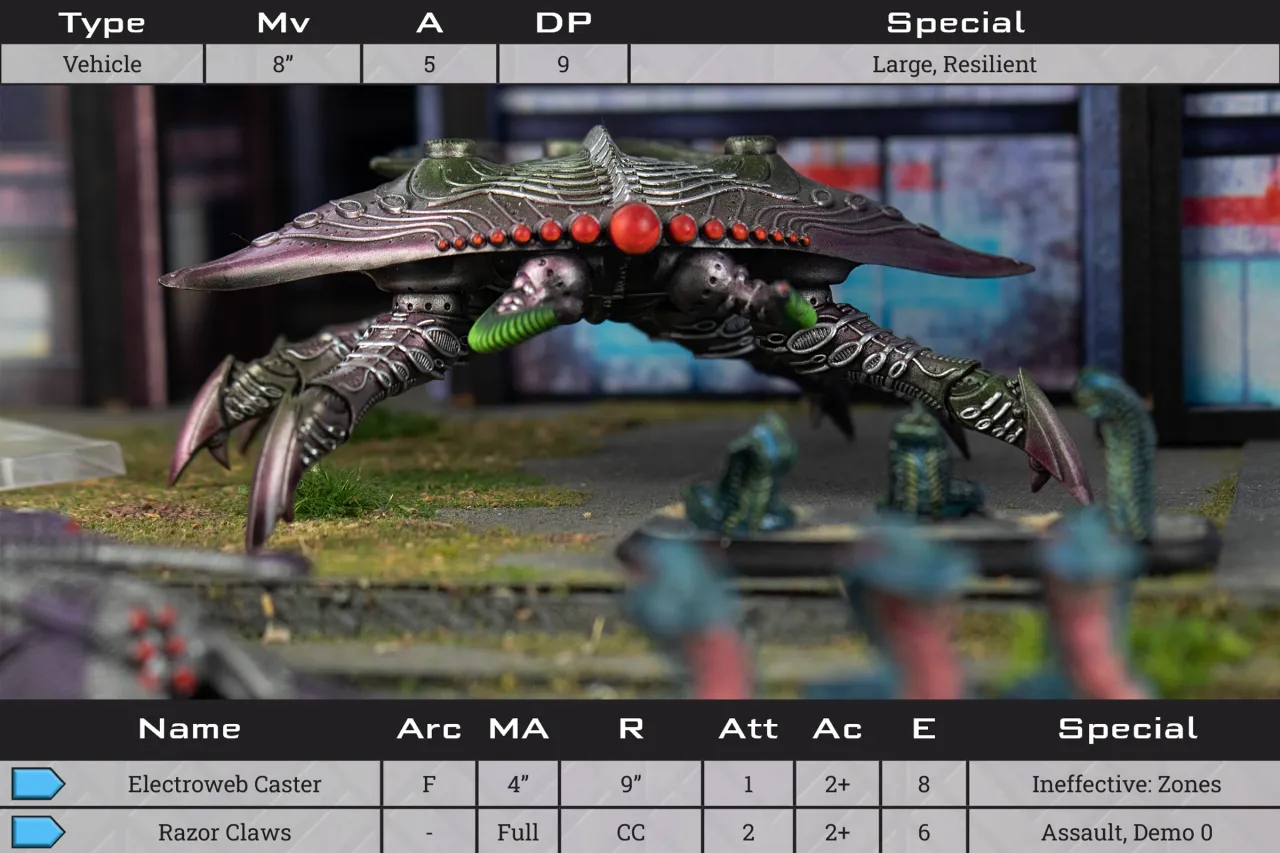
The Subjugator’s real threat is in its aptly named Subjugation Field, however. This weapon does no damage, but has the Suppress rule: When a Squad is hit by a weapon with Suppress, they gain a Suppressed Status Token*** – Suppressed Squads may only move or attack. This can range from merely inconvenient to game-defining, depending on what gets Suppressed and when.
Coming out of the walls
The Scourge’s knifefight-range brutality extends to their infantry as well. Scourge parasites are not limited to human or humanoid hosts, and while the intellectual limitations of a hijacked body make lesser creatures unpleasant hosts, the Scourge are not above using living weapons like the infamous Razorworms.
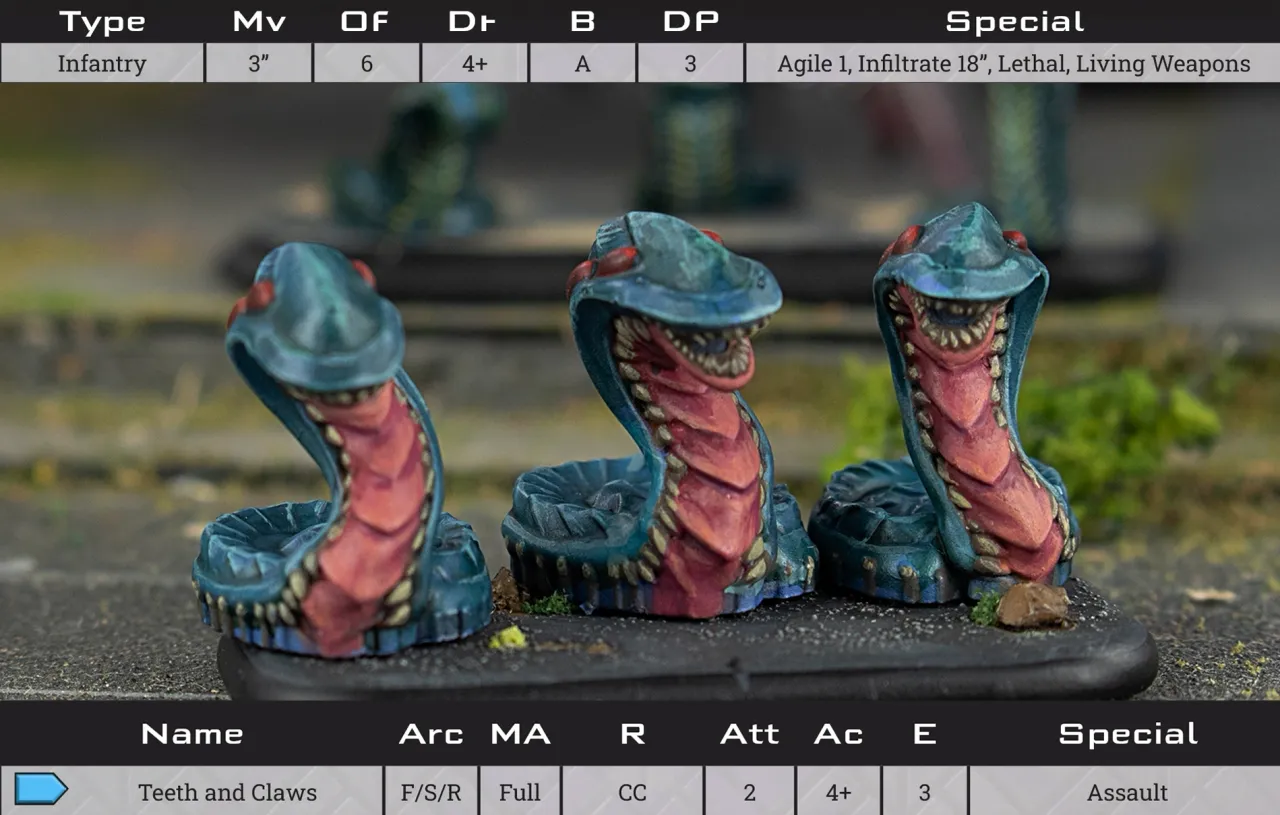
The Living Weapons rule prevents the worms from ever carrying Objects – something we’ll cover in the next article – but their violence more than makes up for it. At OF 6 they punch hard, and the Lethal rule means they automatically hit in CQBs, regardless of who controls the Zone they’re in! Agile 1 meanwhile has them automatically pass one DF save per razorworm in the Squad, and gain +1DF against incoming Collateral Damage, while Infiltrate gives a way to get them on the board without needing a transport****, letting them deploy directly to the board within 18” of your territory (or in a Zone wholly within that range). This makes them excellent landmines, lurking in a Zone near your board edge as a deterrent to incoming infantry.
Does what it says on the tin
The ultimate CQB brutes, however, have to be Eviscerators. These heavy infantry weigh in at a considerable points cost, and Rare prevents you taking too many of them, but their statline very much has you getting what you pay for.
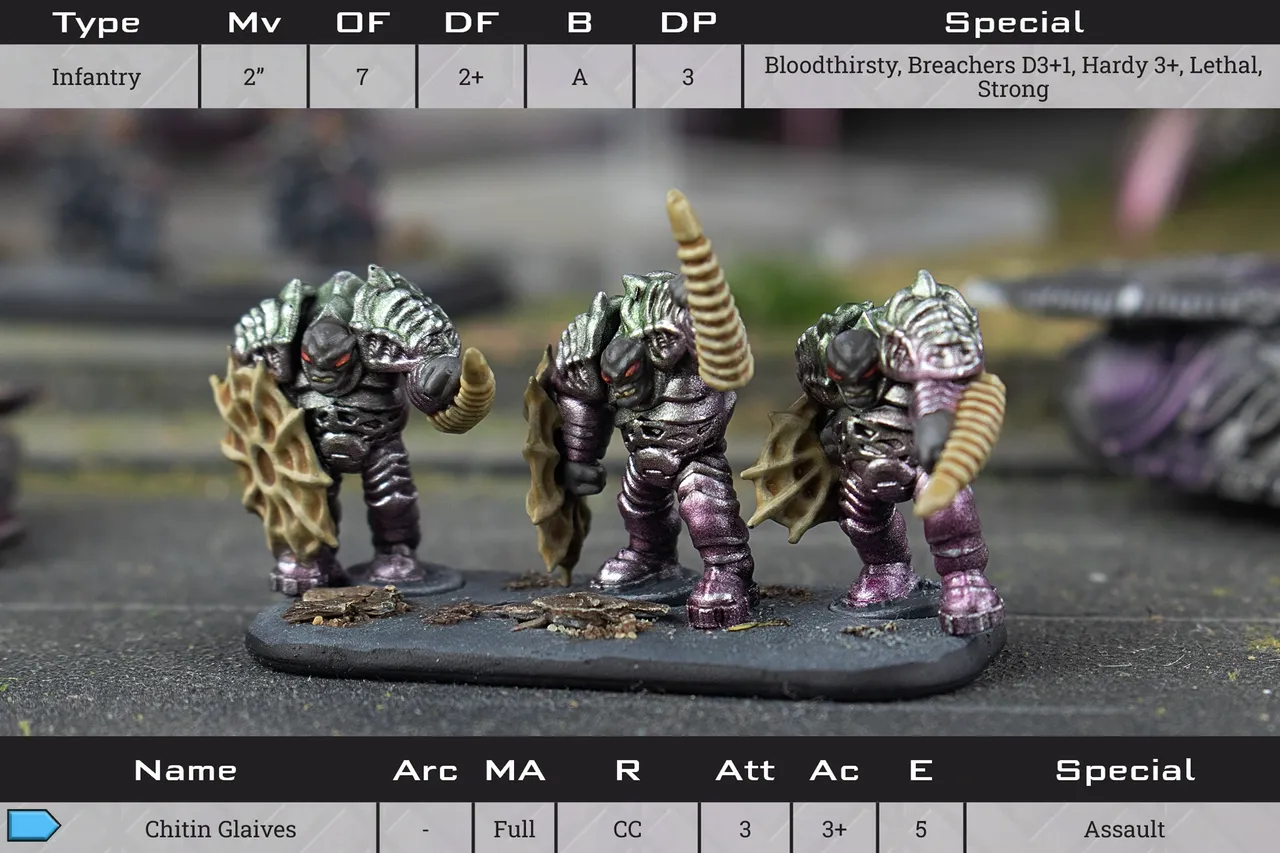
A 2+ DF and Hardy 3+ means they’re not going anywhere without some effort; shrugging off small arms, collateral and even some low energy value weaponry with equal effect. For Offence, their OF of 7 and Lethal has a full strength squad putting out 21***** auto-hits in a CQB, and Strong will have one of their victims suffer a -1 DF penalty for that fight. There is very little in the game that can survive a direct assault by these monsters.
Not only that, but the Breachers X rule has them barging through walls, entering a Zone from any point around it as opposed to just doors and windows, and when they do one unlucky Squad takes 1d3+1 small arms hits, per Eviscerator Unit.
They aren’t a complicated unit, but a canny Scourge player will still have to think about where to place them – they die like any other infantry when the transport or Zone they’re in is destroyed, and enough firepower will wear them down – but with their statline, nothing goes into a fight with these heavy infantry and comes out unscathed.
Unrivaled Brutality
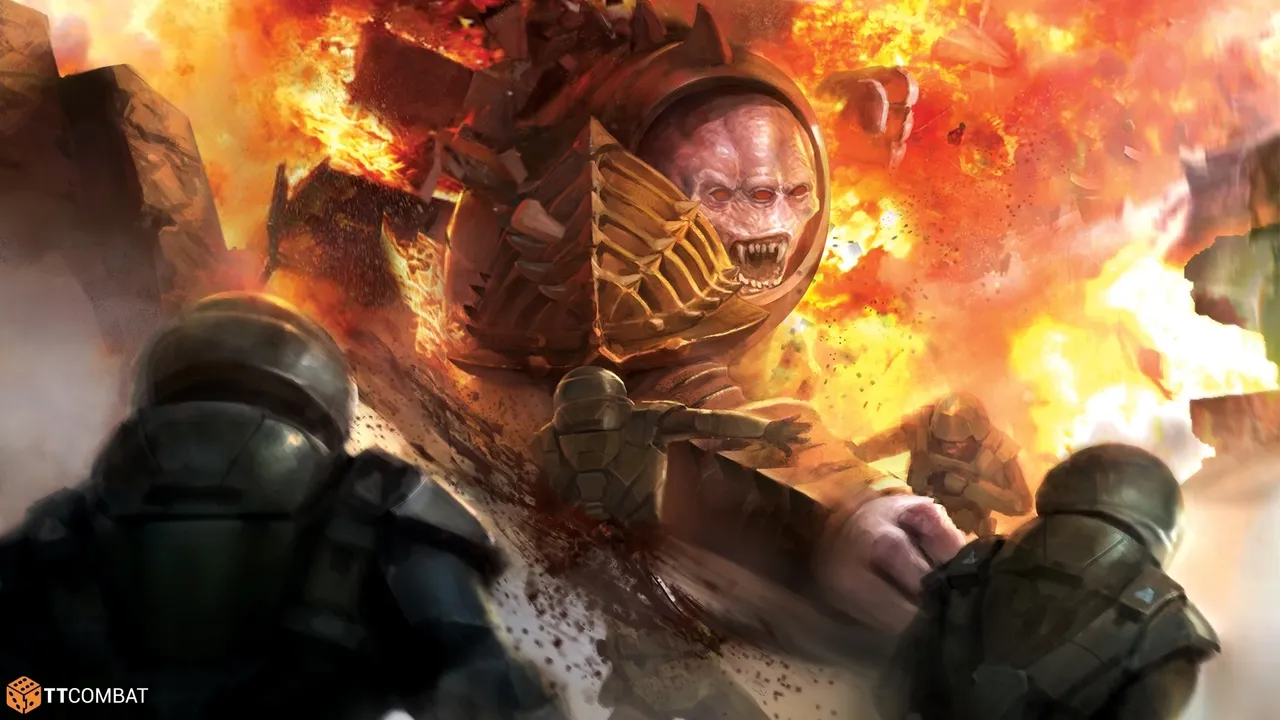
I could probably have saved some digital ink by just having the above section say „Eviscerators: They Eviscerate.“
The Scourge Command Card set features plenty of ways to elevate your CQB output even more.
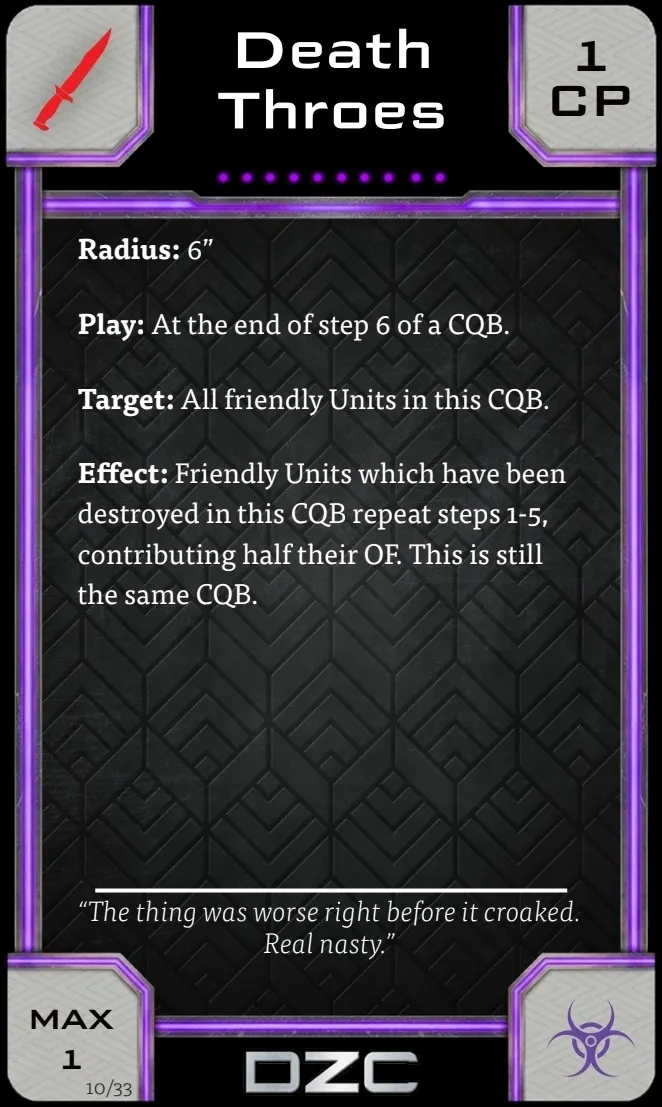
Death Throes lets you have the last word in a firefight, having your destroyed infantry units fight again before finally dying. Even one Eviscerator or Razorworm going down swinging is going to hurt, but a full squad fighting twice can turn your opponent’s clean sweep of the Zone into a bloodbath that’s a Pyrrhic victory at best.
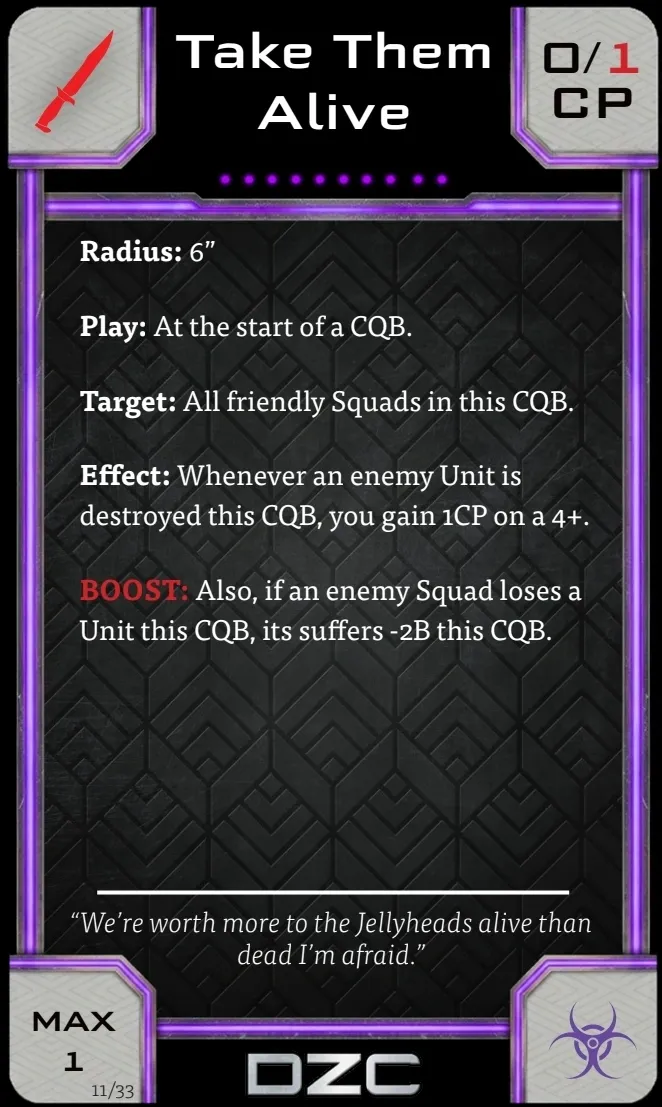
Take Them Alive meanwhile lets your Scourge force play the long game. Usable bodies are hard to find and the Scourge’s ultimate goal is the sustaining of their species, so the chance to take more hosts cannot be missed. This card lets you regain CP as you capture instead of kill the enemy, and adding a CP to it (before the card takes effect, mind) can make the experience so horrifying that the few foes who aren’t taken are more likely to flee in terror.
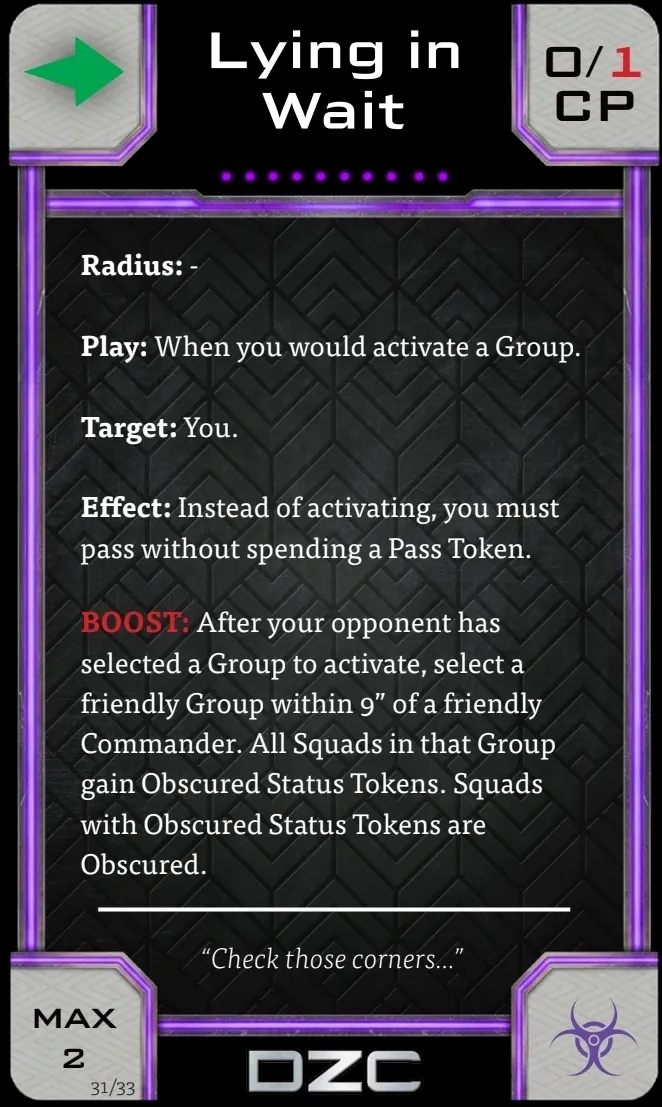
Not all of their cards are just about CQB violence, however. A Scourge force can often play best as ambush predators, forcing the opponent to close to range and then pouncing. Lying in Wait is a deceptively simple card that simply makes your opponent take two activations in a row, while you bide your time and wait for the right moment. The card is free to play by default, but for 1CP you can then make all Squads in a Group Obscured after your opponent decides what to activate, fouling their plans further.
The Scourge are a really fun army to play, combining firepower, speed and devastating close range violence. There’s lots more to show you for them, including several new Infantry units, but that will have to wait – in the next article we’re going to talk about Objectives and Scenarios.
*When shooting into a Zone with friendlies and enemies, missed shots from a Flame weapon are assigned to a random friendly Squad instead. Some factions would baulk at this, but the Scourge are often happy to sacrifice everything for the species.
**Assault normally confers a -2 Accuracy penalty, but this is reduced to just -1 for weapons with CC range. Quite a few units with melee weapons – hammer-wielding Type-9 Walkers, shambling flesh monstrosities like the Hand or the Beta, many Scourge scuttlers and even some infantry – get this rule.
*** Status Tokens are a new streamlined and standardised version of a lot of effects units can put on each other. Obscured, Suppressed, Concussed and Jammed are all tokens that can be handed out by various units and effects, and last until the end of the target Squad’s activation (or end of their next Activation if the squad are targeting themselves, such as a UCM Katana Light Tank popping concealing smoke on itself).
****And Razorworm transports are quite limited. Now a different transport type to regular infantry, they can only be deployed via Heavy Skimmers like Slayers or Tormentors, or launched directly into Zones via a Corruptor Hiveship’s Razorworm Pods as the ultimate shock troops.
***** Eviscerators and Demolishers are now squad size 2-3, meaning you can take a full Invader APC of these blenders.
Quelle: TTCombat



Kommentare