

Monsterpocalypse: Tenshi Seigikan Tempel im Tribe
Privateer Press sprechen über den Tenshi Seigikan Tempel und Damage Control Regeln.
UNEARTHING THE TENSHI SEIGIKAN TEMPLE
The Elemental Champions have just released with this month’s Tribe offering on MyMiniFactory.com.
And just like that, we’re back!
Welcome, Monsterpocalypse players! It’s been a while since we last got to talk about a new model, and what a model it is! Strap in and let’s talk about the Tenshi Seigikan Temple!
Those poor Elemental Champions, they’ve had it rough. Long confined to the mysterious, near-legendary depths of the Block 6 release, the Elemental Champions (and the Savage Swarm.; but that’s a discussion for another day…) have been without their Faction building for two full editions – until now!
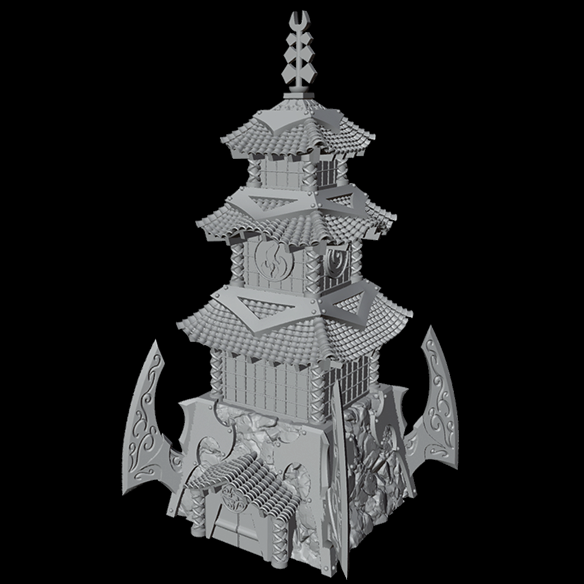
Thankfully, it was worth the wait. Feast your eyes upon the Tenshi Seigikan Temple:
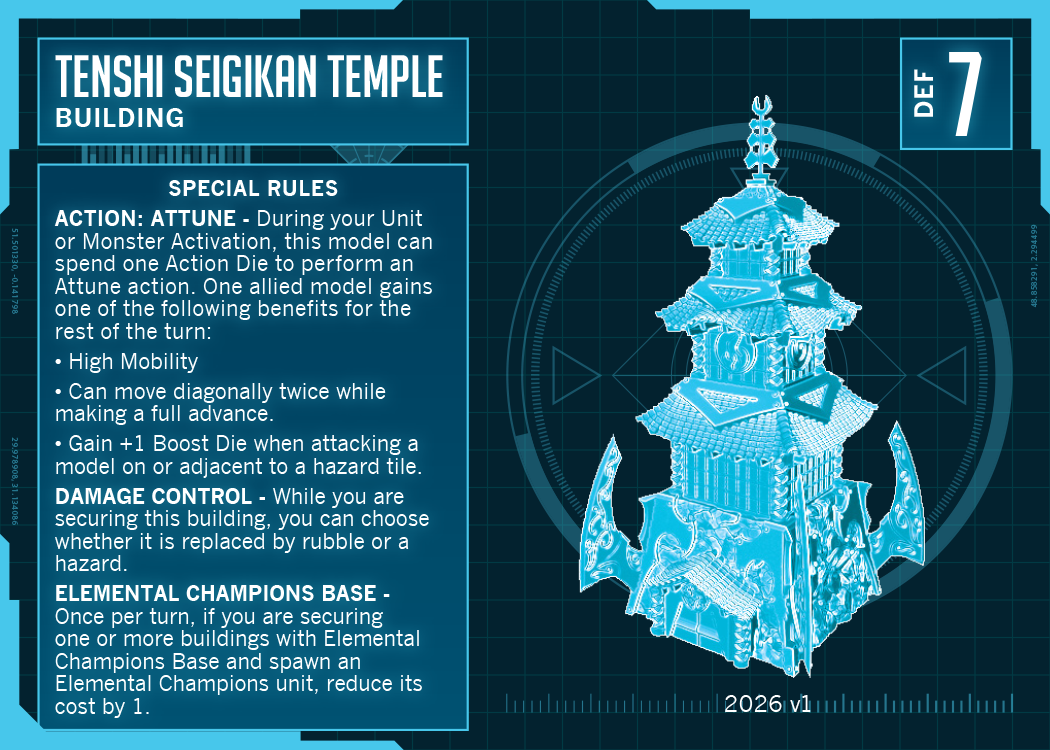
Most of you have probably seen the card previewed on MyMiniFactory, but if you haven’t, let’s take another look:
And what a look that is!
The Tenshi Seigikan Temple comes with the standard “Faction building” rules: like most Faction buildings, it clocks in at a respectable DEF 7 and the associated Faction Base rule provides a discount when spawning Elemental Champions units.
But after that is when things really start to get interesting!
The Elemental Champions embody the four classical elements of earth, air, fire, and water. Astute observers in the community have already noted the connections between those elements and this building’s other special rules, and representing those four elements in-game was one of the key design goals.
Action: Attune allows one allied model to temporarily gain the powers of air, water, or fire. Pedestrian monsters (those who natively lack High Mobility) will greatly appreciate the air-themed benefit, and are sure to enjoy leaping over buildings and vaulting over other monsters with their new-found High Mobility freedom! But remember: this benefit only applies during the model’s Full Advance, and a model can make only one full advance during each activation, so this will not apply to advances granted by special rules such as Action: Blitz or Action: Tectonic Shift.
The water-themed benefit allows a model to move diagonally up to two times when making a full advance. Although it looks tame at first, in practice this makes for some surprisingly fluid and slippery never-before-seen movement tricks.
Hotheads out there will appreciate the fire-themed benefit which grants a model an additional boost die when attacking a model on or adjacent to a hazard time. This applies on all attacks the model makes during a turn, so those models with multiple attacks really appreciate the accuracy boost.
Air, Fire, Water…but what about Earth? Let’s dive into Damage Control, which is a second never-before-seen rule that is new to the game.
Damage Control lets the player securing this building choose whether it leaves a rubble or hazard tile. The exact rules functionality gets a little complex in some cases, but in the end, it works exactly the way intuition suggests it does. (And, for those technically-minded among you, we’ll have an in-depth discussion below.) Having one of your monsters thrown into your own buildings is usually a big blow – it deals both damage to your monster, and deprives you of power dice and special rules in later turns – but Damage Control is a very neat way to slightly soften that blow by allowing the player to prevent a collision with a hazard.
And there you have it: water, earth, fire, and air, all in one neat beautiful package! I know you’re just as excited as we are to get this gorgeous model on the table and start stomping your way through some cities! Get out there and have some fun with your new models!
Or, let’s dive even deeper…
Damage Control Rules Deep Dive
So, let’s talk about how Damage Control really works! As you know, game rules are abstractions that exist for our convenience, which give players a clear way to resolve complicated events. Rules are not perfect simulations of reality, and sometimes this can lead to confusion when intuition clashes with the rules’ steps.
Let’s first go back to the 2022 FAQ and Errata document where this is discussed a bit more (https://home.privateerpress.com/2022/07/25/monsterpocalypse-2022-faq-and-errata/):
- Monsters are placed by power attacks in Timing Step 1 and suffer collision damage in Timing Step 4, but destroyed models aren’t removed from the board until Step 10. How does that work?
The timing chart only applies to the resolution of rules and game effects. Yes, as written, it implies that a monster and a building temporarily share the same space(s), but use your best judgment and physically remove models from the board as appropriate.
Figuring out how Damage Control works is very straightforward in the cases of Blast or Brawl attacks, but what about attacks like Rampages, or Throws, or Body Slams?
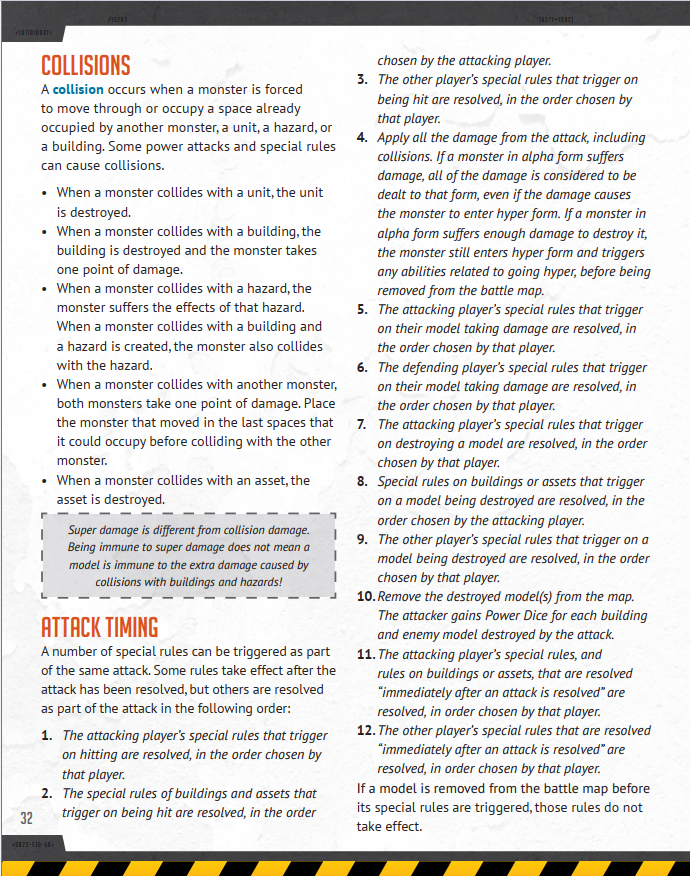
Because the thrown (or slammed) monster is moved before any models are physically taken off the table, from the point of view of the rules, the moved monster temporarily occupies the same spaces as the building and potentially some number of units. Likewise, the “Securing Buildings” rules only check whether the units are physically present on the table when determining if a building is secured. Bearing these facts in mind when reviewing the Attack Timing chart, it’s easy to determine how this rule functions.
Let’s walk through two quick examples of how this works:
Scenario 1: Rob’s monster hits Aaron’s monster with a throw power attack, and ultimately places Aaron’s monster on top of a Tenshi Seigikan Temple that Rob is securing.
- When the attack begins, Rob has 3 units adjacent to the Temple, and there are no enemy models adjacent to the Temple. Rob is securing the Temple.
- Rob throws the enemy monster into the Temple. The thrown monster happens to land on both one unit and the building.
- Step 4 of the Attack Timing chart implicitly requires players to know what kind of debris tile will be left absolutely no later than this point.
- As far as the timing chart is concerned, the monster, building, and unit are currently superimposed.
- “Securing the Building” does not care about the state of the units securing the building, only that they are adjacent as far as the rules are concerned. Destroyed models are not removed from the map until Step 10, but we have not progressed beyond Step 4.
- Rob still has 3 units adjacent to the building, and normally would still be securing the building.
- However, there is now an enemy monster adjacent to the building. Therefore, the building is no longer secured.
- Consequently, as of Step 4 in Attack Timing, Rob can no longer use Damage Control to choose what type of debris tile is left. No other special rules apply, so we know the Temple will leave a hazard, which is the default.
- We progress through the rest of the sequence as normal. Aaron’s monster suffers 3 damage: 1 damage for being hit by an attack, 1 for colliding with the Temple, and 1 more for colliding with the hazard left by the destroyed Temple.
Scenario 2: Liz’s monster hits Paul’s monster with a throw power attack, and ultimately places Paul’s monster on top of a Tenshi Seigikan Temple that Paul is securing.
- When the attack begins, Paul has 3 units adjacent to the Temple, and there are no enemy models adjacent to the Temple. Paul is securing the Temple.
- Liz throws Paul’s monster into the Temple. The thrown monster happens to land on both one unit and the building.
- Step 4 of the Attack Timing chart implicitly requires players to know what kind of debris tile will be left absolutely no later than this point.
- As far as the timing chart is concerned, the monster, building, and unit are currently superimposed.
- “Securing the Building” does not care about the state of the units securing the building, only that they are adjacent as far as the rules are concerned. Destroyed models are not removed from the map until Step 10, but we have not progressed beyond Step 4.
- Paul still has 3 units adjacent to the building. There are no enemy models adjacent to the building, so Paul is still securing the building. We’re required to know what kind of tile the building will leave no later than Step 4 in Attack Timing.
- Because Paul is still securing the building, he can use Damage Control. He chooses to leave a rubble tile.
- We progress through the rest of the sequence as normal. Paul’s monster suffers 2 damage: 1 damage for being hit by an attack and 1 for colliding with the Temple.
“But, how does Damage Control interact with rules that cause buildings not to leave debris tiles at all?” We hear you, and we’ve got that covered as well. There’s precious little space on the standard Monsterpocalypse unit or building card, and economy of phrasing is at a premium, so rules cannot cover every eventuality, and players will need to consult the Attack Timing chart for answers. Remember that Damage Control lets you choose which side of a debris tile to use; it does not allow players to choose whether or not it leaves a debris tile at all. So, if your secured Tenshi Seigikan Temple is hit by a monster with Disintegrate…
DISINTEGRATE – Buildings destroyed by this attack are not replaced by a debris tile.
…there is no debris tile once the attack is resolved. The securing player chose the type of tile back in Step 4, but the attacking player’s special rule disintegrated that debris tile later in Step 7. Try not to get disintegrated!
Until next time, Monsterpocalypsers!
Quelle: Privateer Press


Es macht mich glücklich, dass dieses Spiel offensichtlich ein revival hat. Leicht zu lernen, schwerer zu meistern, grosse Auswahl an Miniaturen und Fraktionen, für jeden was dabei. Minis gefallen mir meist außerordentlich und der Japan Monster Bash Trash ist ein herrlicher Spass.